

2025 Payroll Tax Updates: What’s Changed in Forms 940, 943, 944, and 945
reading time: 16 minute(s)
As the new year begins, payroll filings are just as important as your 1099 and W-2 submissions. With the February 2 deadline fast approaching, it’s time to prepare for the upcoming tax season. There are key changes to Forms 940, 943, 944, and 945 that you’ll want to know about before filing.
In this article, we’ll break down what’s new in the 2025 versions of these forms and what you need to do to stay compliant—without any last-minute surprises.
IRS Updates for 2025 Payroll Forms
Below is a detailed breakdown of the 2025 updates to each annual payroll tax form, explaining what’s new, what’s changed, and what employers and payroll teams should review to ensure accurate and compliant filings this tax season.
Form 940 – Employer’s Annual Federal Unemployment (FUTA) Tax Return
1. New section for aggregate return filers
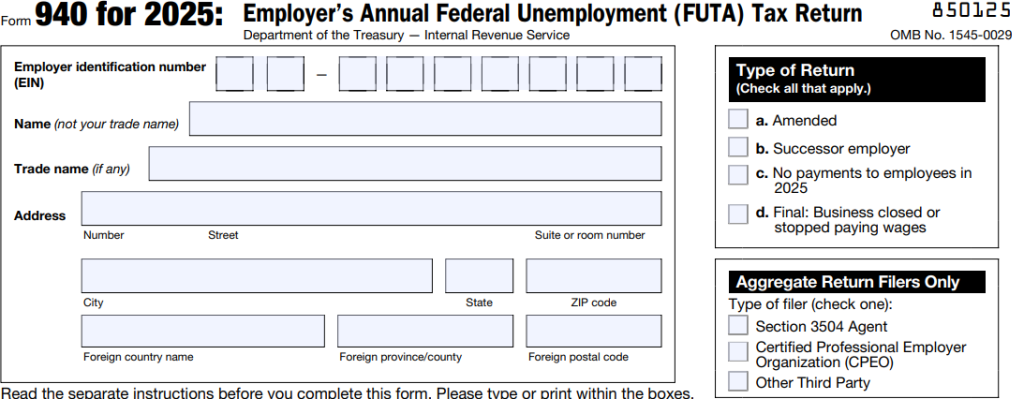
In the 2025 Form 940, you’ll notice a new section where you can select your filer type if you file as an aggregate filer. You can select whether you are a:
- Section 3504 Agent
- Certified Professional Employer Organization (CPEO)
- Other Third Party Filer
This helps the IRS correctly identify your filing status when you submit returns on behalf of multiple employers.
2. Overpayment and direct deposit options (Line 15a to 15e)

Form 940 for 2025 also includes enhanced options for handling overpayments and refunds:
- Line 15a (Overpayment): If the total FUTA tax deposited (line 13) is more than the tax owed (line 12), you must enter the overpayment amount here.
- Line 15b (Overpayment use): You can choose how to use the overpayment, either applying it to next year’s return or requesting a refund by selecting the appropriate box.
- Lines 15c to 15e (Direct deposit information): To make refunds faster and easier, you can now provide your bank details — routing number, select your account type (checking or savings), and account number, to receive your refund via direct deposit.
Form 943 – Employer’s Annual Federal Tax Return for Agricultural Employees

Form 943 for 2025 has a new section (Lines 12c to 12e) that allows you to receive overpayment refunds via direct deposit. If the total deposits (Line 10) exceed the total tax due (Line 9), you can:
- Line 12a (Overpayment): Enter the overpayment amount.
- Line 12b (Overpayment option): Choose whether to apply the overpayment to your next return or request a refund.
- Line 12c to 12e (Direct deposit information): If requesting a refund, provide your bank routing number (12c), select account type (12d)-checking or savings, and account number (12e) to deposit the refunds.
This change speeds up the refund process and makes it more convenient.
Form 944 – Employer’s ANNUAL Federal Tax Return

The 2025 Form 944 features a clearer section for managing overpayments.
- Line 12a (Overpayment): If your total deposits (line 10) exceed your total tax liability (line 9), enter the overpaid amount here.
- Line 12b (Refund Option): You can choose how to handle the overpayment:
- Apply to the next return to carry the overpaid amount forward to reduce next year’s liability, or
- Request a refund to obtain a direct refund from the IRS.
- Line 12c (Routing number): Enter your bank’s 9-digit routing number to enable direct deposit.
- Line 12d (Account type): Indicate whether your refund should go into a checking or savings account.
- Line 12e (Account number): Enter your full bank account number to receive the refund via direct deposit.
Form 945 – Annual Return of Withheld Federal Income Tax

Form 945 for 2025 includes expanded options for handling overpayments and refunds:
- Line 6a (Overpayment): If the total federal income tax withheld (line 4) exceeds the tax liability (line 3), enter the overpayment amount here.
- Line 6b (Overpayment use): You can choose whether to apply the overpayment to your next return or request a refund by checking the appropriate box.
- Line 6c (Routing number): Enter the nine-digit routing number of your bank. This number identifies your financial institution and is required to process direct deposits accurately.
- Line 6d (Type of account): Indicate whether your bank account is a checking or savings account. This helps ensure the refund is deposited into the correct type of account.
- Line 6e (Account number): Enter your bank account number where you want the IRS to deposit your refund. This is the unique number assigned to your account by your bank.
Bonus: Tips to prepare for the final forms
Before filing these forms, here are a few smart steps you can take to stay ahead of the deadline:
- Review your past filings: Go over your previous year’s 940, 943, 944, and 945 returns to check for any errors, overpayments, or refund patterns. Identifying common issues early can help you avoid repeated mistakes in the upcoming year.
- Get your direct deposit info ready: Updated forms now include direct deposit options for refunds. To expedite the refund process, please have your business bank account information, including the routing number, account type, and account number, ready to enter.
- Confirm third-party filer status: If you file on behalf of multiple clients or businesses (e.g., as a CPEO or Section 3504 Agent), review your current designation. The IRS now requires you to indicate this on specific forms, such as the updated Form 940.
- Stay informed on form releases: Subscribe to IRS updates or use a reliable e-filing solution provider that alerts you about form changes, due dates, and filing requirements.
Final thoughts on the 2025 IRS annual payroll forms
The IRS’s Forms 940, 943, 944, and 945 for the 2025 tax year offer a helpful preview of what employers can expect in the upcoming tax season. Staying informed about these updates will help you file your taxes correctly and on time.
TaxBandits can simplify your payroll tax compliance with ease!
Leave a Comment