

The Hidden Risks in Recipient Copy Mailing—and How TaxBandits Simplifies Entire Process
reading time: 20 minute(s)
For many of you, the filing process feels finished once forms are accepted by the IRS. Confirmation emails are saved, and attention quickly moves to the next deadline.
But then the emails start coming in.
“I haven’t received my 1099 yet”
“Are you sure my form was mailed?”
“I need this to file my return—can you resend it?”
This means the filing is complete, but compliance is not.
Why recipient copy mailing matters just as much as filing
Recipient copy distribution is not a follow-up activity. It is a statutory compliance requirement under IRS regulations, and it carries the same importance as filing itself.
It enables the recipients to:
- Prepare their personal tax returns accurately
- Report income without discrepancies
- Respond confidently during audits or IRS inquiries
When recipient copies are late, incorrect, or missed entirely, the consequences are immediate:
- IRS penalties for failure to furnish on time
- Disputes from recipients claiming non-receipt
- Loss of trust and professional credibility
For tax professionals and organizations filing at scale, even a small percentage of missed or delayed recipient copies can translate into significant operational follow-ups, reputational risk, and avoidable compliance exposure.
This is why recipient copy distribution cannot be treated casually. It is a mission-critical step that directly impacts compliance accuracy, recipient confidence, and audit readiness.
The hidden challenges and risks in recipient copy mailing
Postal mailing rarely fails in obvious ways. In most cases, everything looks fine until recipients start following up or returned envelopes arrive weeks later. By then, deadlines are already behind you.
What makes postal mailing risky is not one single issue, but a combination of small gaps that quietly add up.
Address accuracy issues
Recipient data is not static. Addresses change, details get missed, and records are not always updated on time. Even a small mistake can prevent delivery.
Common issues include:
- Outdated recipient addresses
- Missing apartment or unit numbers
- Incomplete or incorrect ZIP codes
When mail is returned due to address issues, it often happens after the IRS deadline, creating both compliance and operational stress.
Delivery delays and timing uncertainty
Even when addresses are correct, delivery timing is not always predictable. USPS processing times vary, especially during peak filing months like January and February.
During high-volume periods:
- Mail can take longer to process
- Delivery estimates become less reliable
- Filers are left guessing whether recipients will receive copies on time
Sending mail on time does not always guarantee timely delivery, which makes planning difficult.
Limited visibility after mailing
Once recipient copies are mailed, visibility becomes a challenge. Many filers struggle to answer basic questions such as:
- Has the mail been postmarked yet?
- Was it sent before the deadline?
- What should I tell a recipient who claims non-receipt?
Without clear tracking, responding to these questions becomes time-consuming and uncertain.
Re-mailing and additional overhead
Returned mail triggers a chain reaction of extra work. Address corrections must be made, forms need to be reprinted, and postage costs increase. All of this happens during the busiest part of filing season, when time and resources are already stretched.
Compliance and audit exposure
The biggest risk appears when proof is required. During an IRS inquiry or audit, filers may be asked to demonstrate that recipient copies were furnished on time. Without centralized records or mailing confirmation, this becomes difficult. These challenges are not edge cases. They are common filing-season realities when postal mailing is handled without the right system in place.
How TaxBandits brings structure and accountability to postal mailing
At TaxBandits, we approached recipient copy mailing as a compliance process, not a logistical afterthought.
Instead of treating mailing as a downstream activity, we embedded it directly into the filing workflow. This ensures that filing, furnishing, tracking, and documentation remain connected from start to finish.
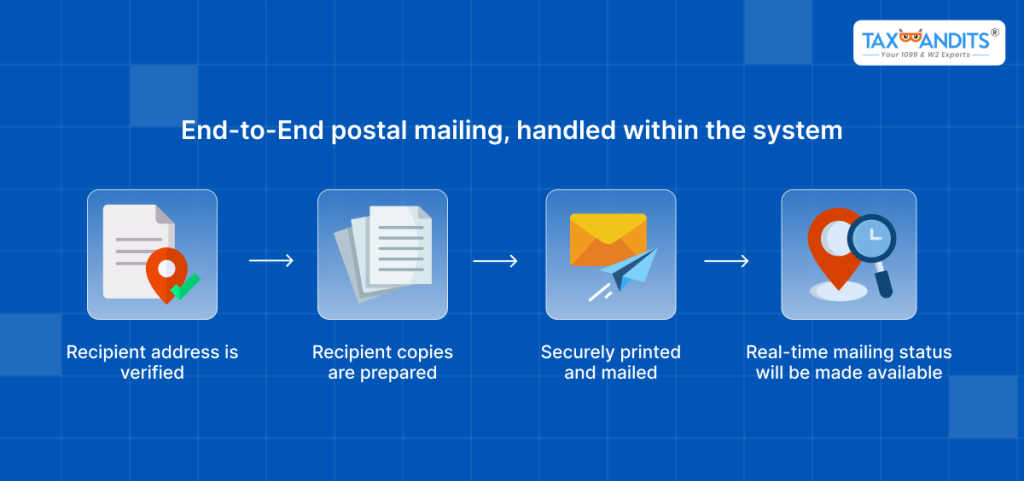
End-to-end postal mailing, handled within the system
When postal mailing is enabled, TaxBandits manages the full mailing process on your behalf. This includes preparing recipient copies in IRS-compliant formats, validating addresses, printing securely, and mailing through established carrier processes.
- Mailing actions are tied to the filing timeline, not handled independently
- Recipient copies are automatically generated in a compliant format
- Forms are securely printed and packaged
- Envelopes are mailed on your behalf through a tracked carrier process
This removes the need for manual printing, envelope handling, and postmark coordination on your end.
Built-in address validation and accuracy checks
One of the biggest causes of failed delivery is inaccurate address data. That’s why we perform address validation before mailing and cross-check records to reduce the risk of returned mail.
This step helps identify:
- Incomplete address records
- Formatting issues that could disrupt delivery
- Data inconsistencies that increase the likelihood of returns
Address validation before mailing minimizes rework, avoids unnecessary delays, and reduces the need for corrective actions after deadlines have passed.
Centralized mailing visibility
Postal mailing should not feel like a black box. We offer a clear visibility into mailing status, so you’re not left guessing.
You can quickly confirm:
- When forms were prepared
- When they were postmarked
- Whether the mailing was completed before the deadline
This makes it easier to respond confidently when recipients follow up.
Designed to reduce stress during filing season
Recipient copy mailing becomes most fragile when volume peaks.
TaxBandits plans for high-volume filing periods well in advance, aligning mailing workflows with IRS deadlines and USPS processing realities.
Our approach emphasizes preparation and predictability:
- Daily, scheduled postmark processing
- Advance planning for seasonal volume spikes
- Coordination around USPS cutoff windows and processing timelines
These measures help ensure mailing consistency even during the busiest weeks of filing season.
The bottom line
Recipient copy distribution is more than a mailing task, it’s a compliance obligation.
Postal mailing carries real risks, but they are manageable when you have the right system in place. With TaxBandits, you can:
- Reduce manual steps and operational complexity
- Track every mailing with clear visibility
- Ensure forms reach recipients accurately and on time
We manage the complexity behind recipient copy mailing so you can focus on your clients, your work, and your deadlines—not on tracking envelopes or resolving uncertainty.
In the next post of this series, we’ll take a closer look at how postal mailing is handled within TaxBandits, from initiation through furnishing confirmation, so you can better understand what happens behind the scenes and how each step supports compliance.
With the year-end filing season approaching, now is the right time to prepare. Getting started with TaxBandits early helps you organize filings, manage recipient copy distribution with greater confidence, and stay ahead of upcoming deadlines.

Leave a Comment