

reading time: 27 minute(s)
In tax compliance, responsibility doesn’t begin at submission, and it certainly doesn’t end there.
A filing may be transmitted in seconds, but its implications can surface months or even years later. Notices arrive. Corrections are required. Questions come back when people least expect them. And in those moments, what matters isn’t how fast the system worked—it’s whether the outcome holds up.
That reality shaped how we define our role at TaxBandits.
We don’t see compliance software as a transaction engine. We see it as an accountability system, one that must support confidence across the entire lifecycle of a filing, not just at the moment it’s submitted.
That belief is what we call The Bandit Commitment.
What the Bandit Commitment ultimately means
The Bandit Commitment is not a feature, a program, or a promise made in passing. It is a standard we hold ourselves to in how we build, operate, and support our platform.
At its core, the Bandit Commitment exists to deliver one thing: confidence in the outcome. Not just helping you complete an e-file submission, but ensuring the result holds up.
When filers trust that responsibility does not end at submission, peace of mind follows naturally. That is the standard we believe tax compliance deserves, and the one we continue to build toward every day.
E-file submission vs. outcome
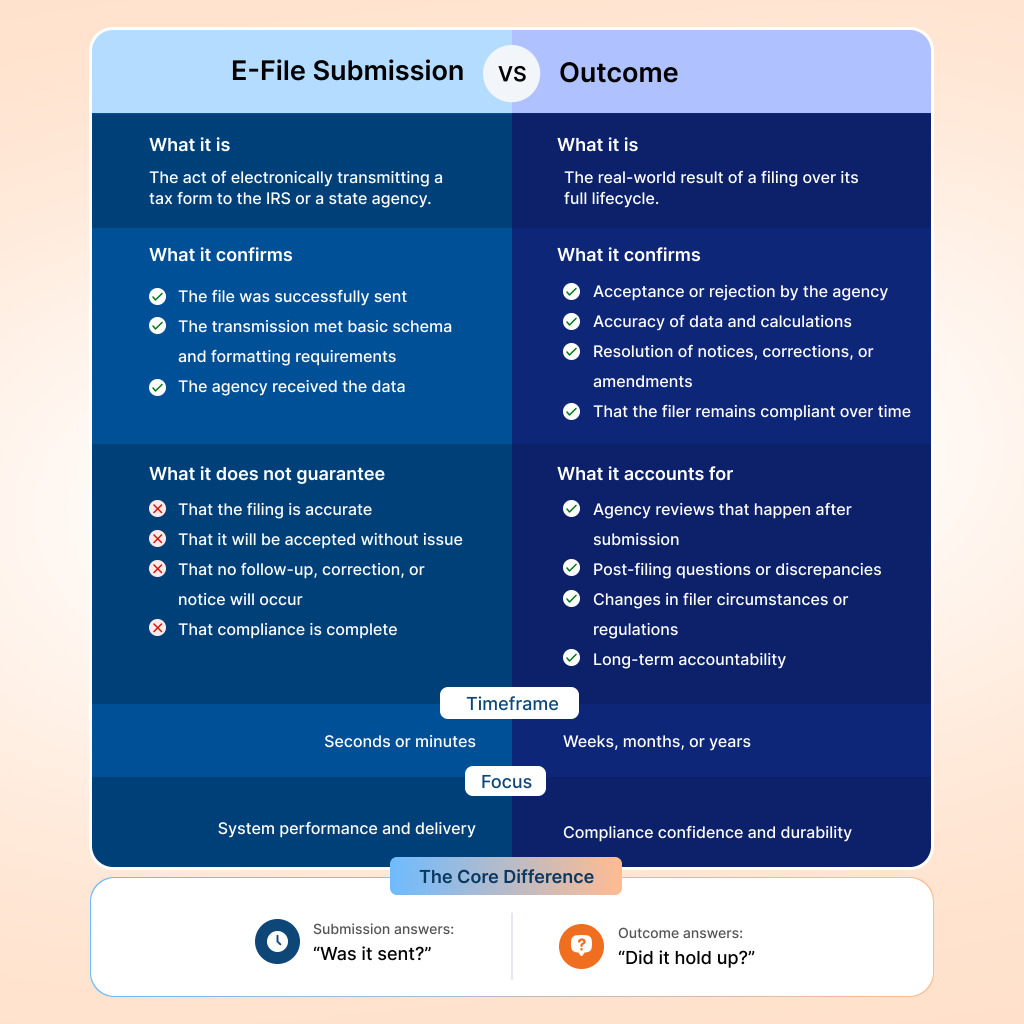
This distinction matters in tax compliance, because it is easy to confuse submission with success.
E-file submission is a technical event. It confirms that a form was transmitted, that it met basic schema and formatting requirements, and that the agency received the data. That process typically takes seconds or minutes, and its focus is delivery. But submission alone does not define compliance.
The outcome of a filing unfolds over time. It reflects whether the return is accepted, whether the data holds up under review, whether corrections or notices are resolved, and whether the filer remains compliant weeks, months, or even years later.
Submission answers a narrow question: Was it sent?
Outcome answers the one that actually matters: Did it hold up?
Submission is a moment.
Outcome is a responsibility.
The Bandit Commitment is built around that responsibility. It is why we focus on what happens before filing, how issues are surfaced during the process, and how accountability is carried forward after submission.
Getting the right data in before filing begins
Reliable outcomes in compliance start well before a form is created.
In our experience, most downstream issues can be traced back to a much earlier point: how data enters the system, how it is interpreted, and whether it is understood correctly from the start.
That is why the Bandit Commitment begins at ingestion.
We believe filers should be able to bring data into the system in ways that reflect how they actually work. TaxBandits provides flexible ways to get data into the system, including CSV uploads, no-code integration, and API. Plus, the built-in W-9/W-8 Manager at no extra cost supports a compliance best practice: collecting recipient information directly from vendors and payees securely and at no additional cost.
Once data is in, the focus shifts to accuracy.
Built-in form validations, TIN verification, USPS address checks, including change of address (National Change of Address – NCOA) tracking, and Smart Review workflows continuously evaluate the data, flagging issues while they can still be corrected—before they turn into rejections, notices, or downstream fixes.
This is how confidence is built quietly, long before filing day arrives.
Guidance built into the workflow
Compliance is not intuitive, even for experienced filers. That is not a flaw in the filer. It is the nature of regulated work.
For that reason, we view guidance as part of the filing experience itself, not something added after the fact.
Clear explanations, structured walkthroughs, and practical examples help filers move forward with confidence. Plus, our AI assistant and co-pilot help surface relevant information, highlight potential issues, and guide decisions in context.
When complexity requires judgment, experienced human support must be present, accountable, and accessible.
At TaxBandits, world-class support is not abstract. It means real people are available when filers need help, through live chat, phone, and email, with the context of the filing in front of them. Questions are not routed blindly or deferred until later stages. They are addressed clearly, efficiently, and with an understanding of what is at stake.
Support should not end at submission, and responsibility should never be redirected back to the filer. Standing behind a filing includes standing behind the questions, clarifications, and follow-up that occur after it is transmitted.
This level of availability is not an add-on.
It is part of the compliance lifecycle.
One solution for end-to-end compliance
Compliance does not end when a return is filed. In many cases, that is where additional responsibilities begin.
Federal and state requirements must be met together, not in isolation. Some filings require state-only submissions. Others involve reconciliation rules that vary by jurisdiction. Distribution is not optional, and how forms are delivered matters just as much as when they are submitted.
Our approach has been to treat these steps as part of a single, connected workflow.
At TaxBandits, federal and state filings are supported within the same system, including state-only obligations where required. Form distribution is built directly into the process, with both electronic delivery and postal mailing handled as part of the filing lifecycle, not as a separate afterthought.
State-specific rules are accounted for within the system, including reconciliation requirements, so critical obligations are not left to memory or manual tracking. The intent is simple: reduce fragmentation and remove uncertainty by ensuring each step connects cleanly to the next.
Standing behind the filing after submission
Accountability matters most after the work appears to be finished. That is where commitment is tested, and where it counts.
Even with strong preparation, circumstances change. A filing may be rejected. Information may need to be corrected. Regulations may evolve. These moments are not exceptions to responsibility. They are part of it.
The Bandit Commitment is most visible in these moments.
When something needs to be fixed, it should be fixed without added friction. The Bandit Commitment means you aren’t charged again for fixing what should have worked the first time.
That’s why,
- Corrections are included with the original filing fee.
- Rejected forms are retransmitted without additional cost.
The objective is resolution, not repetition.
It also means removing uncertainty around outcomes. The money-back guarantee exists to reflect accountability. If we ask filers to trust the result, we have to be willing to stand behind it financially as well.
Standing behind a filing also means accounting for what happens after acceptance. In tax compliance, that often includes IRS notices that arrive later, sometimes months after a return is filed. When that happens, filers can simply upload the tax notice to TaxBandits and receive guided support through the resolution process. Managing these moments should not require starting over or retracing steps. It is part of ensuring the outcome truly holds up.
This is how peace of mind becomes real! Not because issues never arise, but because responsibility does not shift back to the filer when they do.
The work you do not see, but depend on
The most important parts of compliance rarely announce themselves.
Confidence is not created by what a filer clicks or sees on screen. It is created by systems that perform consistently in the background, under conditions most people never experience directly.
That includes safeguards that protect sensitive data at all times, not just during filing. Infrastructure designed to hold up during deadline spikes, not just on quiet days. Controls that anticipate misuse, error patterns, and regulatory scrutiny before they surface as problems.
It exists so filers do not have to think about security, scale, or failure modes when they are focused on meeting obligations and deadlines. The absence of disruption is not an accident. It is the result of design choices made with long-term trust in mind.
The best compliance systems do not demand attention.
They earn reliance.
That quiet dependability is not incidental to the Bandit Commitment. It is one of its foundations.
Anti-fraudulent filing prevention measures
Another part of compliance that rarely draws attention, but matters deeply, is prevention.
Fraudulent or high-risk filings do not always announce themselves clearly. They often surface through patterns, inconsistencies, or behavior that only become visible when systems are designed to look for them.
Behind the scenes, protective measures operate continuously to identify and reduce risk before it turns into a larger compliance issue. These controls are not designed to slow legitimate filers down. They exist to protect the integrity of filings and the trust placed in the system.
When prevention works well, it is quiet.
And that quiet protection is intentional.
Why this standard matters
Tax compliance is not getting easier. Volumes grow. Rules evolve. Expectations increase. And the margin for error continues to narrow.
In that environment, filers do not need more tools to manage complexity. They need systems that assume responsibility for it. That is what the Bandit Commitment is designed to do. Not by promising perfection, but by setting a clear standard for how compliance should be handled when real-world conditions intervene.
For us, this is not about differentiation. It is about discipline. About choosing to build software that carries accountability across the full lifecycle, even when that work is invisible and inconvenient.
The outcome filers care about is simple: confidence that holds up over time.
That is the standard we continue to build toward. And it is the responsibility we believe comes with operating in tax compliance at scale.
Leave a Comment