

Treasury Tipped Occupation Codes: Understanding Box 14b on 2026 Form W-2
reading time: 17 minute(s)
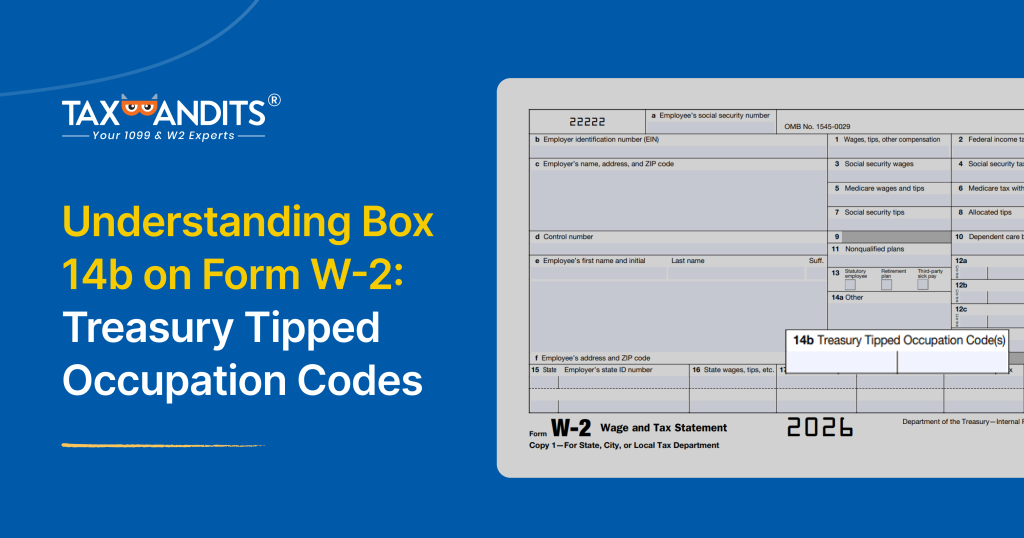
Form W-2 has a new box for 2026, and it’s easy to miss. Box 14 is now split into Box 14a and Box 14b. While Box 14a remains the same, Box 14b serves a new purpose: reporting an employee’s Treasury Tipped Occupation Code (TTOC). If you run payroll or prepare W-2s, here’s what changed and what to do about it.
How Treasury Tipped Occupation Codes Work
A Treasury Tipped Occupation Code (TTOC) is a three-digit code that identifies the specific occupation in which an employee earned reported tips. The IRS and Treasury Department finalized the code system to implement the “No Tax on Tips” deduction under the One Big Beautiful Bill Act (OBBBA).
The list covers 71 tipped occupations, grouped into eight numbered series. The final rule also added three occupations omitted from the preliminary list. Personal Services picked up visual artists and floral designers, while Transportation and Delivery gained gas pump attendants.
The Treasury Tipped Occupation Code Series
Rather than list occupations together, the IRS organized them into eight series codes, grouped by the kind of work involved. Here’s what’s in each one:
- 100s — Beverage and food service.
Restaurant and bar roles: bartenders, wait staff, chefs and cooks, food prep workers, dishwashers, hosts, and bakers. Codes include 101–110. - 200s — Entertainment and events.
Casino and live-entertainment roles: gambling dealers, cashiers, and runners, along with dancers, musicians, DJs, performers, digital content creators, and venue staff like ushers and coat-check attendants. Codes include 201–211. - 300s — Hospitality and guest services.
Hotel-facing roles: baggage porters and bellhops, concierges, front desk clerks, and housekeeping staff. Codes include 301–304. - 400s — Home services.
Tradespeople and technicians who work in private homes: general repair workers, landscapers, electricians, plumbers, HVAC technicians, appliance repairers, home cleaners, locksmiths, and roadside assistance workers. Codes include 401–409. - 500s — Personal services.
A mix of individual-client roles: personal care aides, event planners, photographers and videographers, officiants, pet and show animal caretakers, tutors, nannies, and, new in the final rule, visual artists and floral designers. Codes include 501–510. - 600s — Personal appearance and wellness.
Beauty and grooming roles: skincare specialists, massage therapists, hairstylists and barbers, nail technicians, makeup artists, fitness instructors, tattoo artists, tailors, and shoe repairers. Codes include 601–611. - 700s — Recreation and instruction.
Leisure and teaching roles: golf caddies, self-enrichment teachers, tour and recreational pilots, tour and travel guides, and sports instructors. Codes include 701–706. - 800s — Transportation and delivery.
Driving and delivery roles: parking and valet attendants, taxi and rideshare drivers, shuttle drivers, delivery couriers, vehicle cleaners, bus drivers, water taxi operators, carriage drivers, movers, and, newly added, gas pump attendants. Codes include 801–810.
Each series groups roles that share a work setting rather than a job title, so it’s worth checking the description for a code, not just the title, before assigning it.
When Should Employers Report the Code?
Box 14b is only required when an employer is also reporting Box 12 Code TP (Cash Tips Reported to the Employer) for that employee. If an employee didn’t report cash tips during the year, Box 14b stays blank.
Employers can report up to two codes per employee: a Primary code for the employee’s main tipped occupation, and a Secondary code if the employee earned reported tips in a second qualifying role during the year.
Note: The wrong code or a blank code when it applies can block an employee from claiming a deduction they’re otherwise entitled to.
Why the TTOC Matters
The Treasury Tipped Occupation Code is the mechanism that ties a reported tip amount to the “No Tax on Tips” deduction under new Section 224 of the tax code. To qualify for the deduction, tips must be earned in an occupation included on the Treasury’s official list. The code reported on an employee’s W-2 helps identify the occupation and establish whether the reported tips meet the eligibility requirements.
A few things determine whether a tip counts as a “qualified tip” for the deduction:
- It has to be paid in cash or a cash-equivalent (check, credit or debit card, gift card, or similar electronic payment)
- It has to be voluntary. A mandatory service charge, like an automatic 18% gratuity on large parties, doesn’t count even if the money eventually reaches the employee
- It has to come from an occupation on the Treasury’s list
What Employers Should Do Before Filing
Before filing for tax year 2026, payroll teams should take a few key steps:
- Identify eligible employees: Determine which employees work in occupations on the Treasury’s official list and assign the correct three-digit code to each employee.
- Check payroll system support: Confirm that your payroll system can capture a Primary Code and, when applicable, a Secondary Code for each employee.
- Validate Box 14b reporting: Ensure Box 14b is populated only when Box 12, Code TP, is also reported.
- Track role changes: Flag employees who move between tipped and non-tipped roles during the year. Their occupation code may need to change, or no code may be required, depending on the occupation in which the tips were earned.
For businesses with multiple job types, especially staffing agencies and multi-service hospitality operators, assigning the right code may require careful classification of employees and roles rather than a simple payroll system update.
Final thoughts
Box 14b may be a small addition to Form W-2, but accurate reporting can make a meaningful difference for tipped employees claiming the “No Tax on Tips” deduction. Getting the occupation code right from the start can help employers avoid corrections and ensure employees receive accurate information when they file their tax returns.
Preparing employee job classifications and payroll systems before Tax Year 2026 reporting begins can help make the transition to the new reporting requirements smoother.
Simplify W-2 filing with TaxBandits, including Box 14b and Box 12, Code TP reporting.
Learn more about W-2 filing with TaxBandits
Leave a Comment