

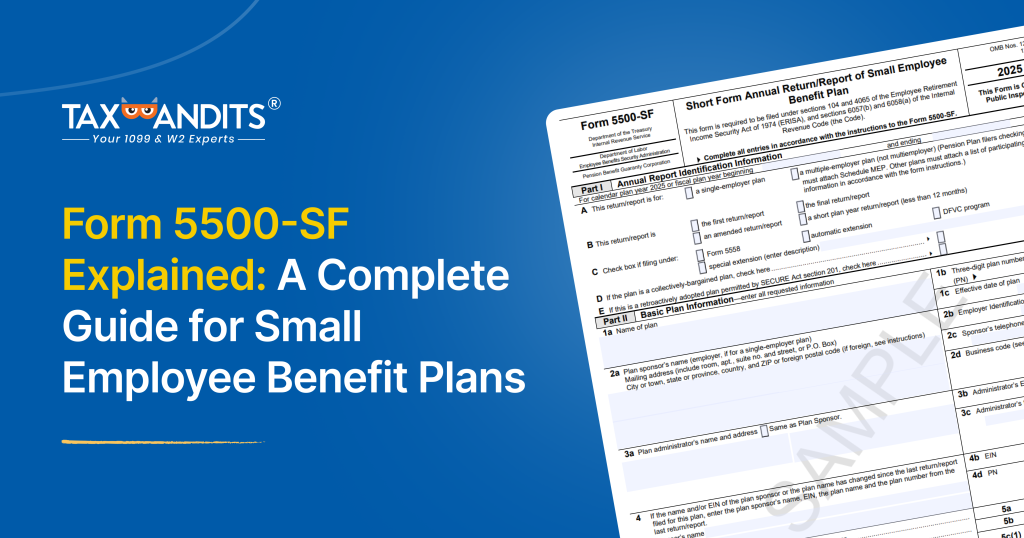
Form 5500-SF Explained: A Complete Guide for Small Employee Benefit Plans
reading time: 39 minute(s)
Picture a business owner who opened a 401(k) two years ago. Contributions go in every payday, and the statements look fine. Then a notice arrives about a missing annual report.
The plan was never the problem. The paperwork was.
For most small plans, that paperwork is Form 5500-SF, the short version of the annual report. This guide covers who qualifies, what the form asks, when it is due, and what a late filing can cost.
What is Form 5500-SF?
Form 5500-SF is the Short Form Annual Return/Report of Small Employee Benefit Plan. Small pension plans and small funded welfare plans use it to report their finances and compliance to the IRS and the Department of Labor (DOL). A plan generally needs fewer than 100 participants at the start of the plan year and must meet asset and audit conditions. It must be filed electronically through EFAST2.
| Question | Short answer |
| Size test | Fewer than 100 participants at the start of the plan year (up to 120 under the 80 to 120 rule) |
| Where to file | EFAST2 only. No paper filing. |
| Due date (calendar-year plan) | Last day of the 7th month after plan year-end (July 31 for calendar-year plans) |
| Extended due date | Up to 2.5 months later with Form 5558 (October 15 for calendar-year plans) |
| DOL penalty | Up to $2,739 per day (unchanged for 2026) |
| IRS penalty | $250 per day, up to $150,000 |
| Is it public? | Yes. Filings are open to public inspection and posted online. |
Who can file Form 5500-SF?
Your plan must meet all three criteria.
1. Size. The plan covered fewer than 100 participants at the start of the plan year. Under the 80-to-120 rule, a plan that filed as small last year can keep doing so with up to 120 participants. For defined contribution plans, count participants with account balances.
2. Assets. Every plan asset must be an “eligible plan asset”: it has a readily determinable fair market value and is held by a regulated institution. Think mutual funds, insurance or bank contracts valued at least annually, publicly traded securities held by a broker-dealer, cash, and participant loans. Real estate and private company stock do not qualify.
3. Audit waiver. Welfare plans with fewer than 100 participants are exempt from audit. A small pension plan must qualify through the 95% qualifying plan assets test. If it relies on the enhanced fidelity bond route instead, it cannot use Form 5500-SF and must file the full Form 5500.
The plan must also hold no employer securities and cannot be a multiemployer plan, a pooled employer plan, a DCG arrangement, an ESOP, or a plan required to file Form M-1.
Who does not need to file Form 5500-SF at all?
Not every plan has to file an annual report. That matters because some sponsors file unnecessarily, and others assume they are exempt when they are not. Per the DOL’s instructions, these plans are exempt from filing:
- SEPs that meet the alternative method of compliance
- SIMPLE IRA plans
- Governmental plans and most church plans
- Fully insured, unfunded, or combination insured/unfunded welfare plans covering fewer than 100 participants at the start of the year
- One-participant plans under Title I (though some must still file Form 5500-EZ with the IRS). Know more
A welfare plan is not treated as “unfunded” if it collected employee contributions or used a trust during the year, with a limited exception for certain cafeteria plans. If your small health plan is funded that way, it may need to file, and Form 5500-SF is often the right form.
Form 5500-SF vs. Form 5500 vs. Form 5500-EZ
| Form 5500-SF | Form 5500 | Form 5500-EZ | |
| Best for | Small plans that pass all three eligibility criteria | Plans with 100+ participants, or small plans that fail an SF condition | One-participant plans and certain foreign plans |
| Schedules | Few. Only SB, MB, or MEP when applicable | Full set as applicable (A, C, H or I, R, and others) | Schedules SB/MB kept on file, in most cases not filed |
| Filed with | EFAST2 only | EFAST2 only | EFAST2 or paper to the IRS (subject to e-file rules) |
| Public on DOL site? | Yes | Yes | EFAST2 filings are not posted publicly |
Important: Since 2021, a one-participant plan can no longer use Form 5500-SF in place of Form 5500-EZ. If it is only you (and your spouse, or your partners and their spouses), you file Form 5500-EZ.
What does Form 5500-SF ask for?
| Part | What it covers |
| I. Identification | Plan year, first/amended/final status, extension boxes |
| II. Basic plan information | Sponsor and administrator details, participant counts, eligibility (lines 6a to 6c) |
| III. Financial information | Assets, liabilities, income, and expenses |
| IV. Plan characteristic codes | Codes describing your plan’s features |
| V. Compliance questions | Late deposits, prohibited transactions, fidelity bond, unpaid benefits, loans |
| VI to VII. Funding, terminations | Minimum funding, plan terminations, transfers |
Part V is where small plans stumble most. Three lines deserve attention:
- Line 10a (late deposits): Plans with fewer than 100 participants get a seven-business-day safe harbor. Report late amounts until they’re fully corrected.
- Line 10c (fidelity bond): Only a bond naming the plan counts. Fiduciary liability insurance does not.
- Line 10e (insurance fees): Broker and agent commissions on plan insurance contracts go here.
Which schedules go with Form 5500-SF?
Usually none. That is the appeal of the short form. There are three exceptions:
- Schedule SB (actuarial information) for single-employer defined benefit plans
- Schedule MB for money purchase plans amortizing a funding waiver
- Schedule MEP for multiple-employer pension plans
Eligible combined plans, which pair a defined benefit plan with a 401(k), must include everything either component would require.
Form 5500-SF due date for 2026
The deadline is the last day of the seventh month after the plan year ends. For calendar-year plans, that is July 31.
For example, a plan year ending December 31 is due July 31. A plan year ending June 30 is due January 31.
- Form 5558 extension: File on or before the normal due date for up to 2.5 months more, which moves a calendar-year plan to October 15. You can file Form 5558 electronically through EFAST2.
- Tax-return extension: If your plan year matches the employer’s tax year and the employer has an income tax extension, the 5500-SF extends automatically, up to 9.5 months after the plan year ends.
Timely reminder: For the 2025 plan year, October 15, 2026 is the last day for calendar-year plans with an approved extension.
How to file Form 5500-SF, step by step
- Confirm eligibility using the three criteria, especially line 6a (eligible assets) and line 6b (audit waiver).
- Gather your data: EINs, plan number, participant counts, year-end balances, contributions, distributions, bond and insurer fee details.
- Set up e-signing. The plan administrator signs through EFAST2 credentials, or authorizes a service provider to sign.
- Complete every line. Answer every yes/no question, and do not type “N/A” unless the form specifically allows it.
- Attach any required schedules. This applies to defined benefit plans and the other exceptions above.
- Submit and verify. Look for “Filing Received” in EFAST2, usually within about 20 minutes. “Processing Stopped” or “Unprocessable” may mean the filing does not count.
- Keep your records. Keep a signed copy with your plan records, and be ready to provide a paper copy to participants, beneficiaries, or the DOL on request.
What happens if you file Form 5500-SF late?
Late or incomplete filings can be penalized by both the DOL and the IRS, and the two penalties are separate.
| Penalty | Amount |
| DOL | Up to $2,739 per day, no annual cap |
| IRS | $250 per day, up to $150,000 |
| IRS, missing Schedule SB or MB | $1,000 |
The DOL did not raise its penalty amounts for 2026, so the 2025 figures still apply. Thirty days late could mean up to $82,170 from the DOL plus $7,500 from the IRS. These are maximums, and relief for reasonable cause may be available.
Already late? Use the DFVC Program
If you missed a filing and haven’t received a notice from the DOL, the Delinquent Filer Voluntary Compliance Program (DFVC) can cut costs dramatically.
| Plan size | Penalty | Per-filing cap | Per-plan cap (multiple late years) |
| Small plan | $10 per day | $750 | $1,500 |
| Large plan | $10 per day | $2,000 | $4,000 |
Seven mistakes that trigger rejections and notices
- Filing Form 5500-SF when a line 6 condition fails. The enhanced-bond audit waiver is the classic case.
- Leaving lines blank or typing “N/A.” The form requires an answer on every line unless told otherwise.
- Entering a Social Security Number as the EIN. Filings are public, and an SSN can cause the filing to be rejected.
- Not reporting a name or EIN change on line 4. You must disclose changes to the sponsor name, EIN, or plan name.
- Beginning balances that do not match last year’s ending balances. Line 7 beginning amounts must tie to the prior year’s report.
- Skipping Schedule SB for a defined benefit plan. This also triggers the $1,000 actuarial statement penalty.
- Submitting and walking away. If you never confirm “Filing Received,” or the administrator’s signature is invalid, the filing may be treated as not filed.
A related note: An amended filing must be a complete replacement. You cannot submit only the corrected pages.
Get your Form 5500-SF filed the right way
Clear the three criteria, answer Part V honestly, and confirm “Filing Received.” That is most of the work.
Ready to file? Get guided through your filing, catch common errors before submission, and e-file your Form 5500-SF quickly and securely with TaxBandits.
E-File Form 5500-SF Now| This article is for general information only and is not legal, tax, or investment advice. Consult a qualified benefits advisor or ERISA counsel about your situation. |
Frequently asked questions
What is Form 5500-SF used for?
It is the simplified annual report for small pension and welfare plans and satisfies both IRS and DOL reporting requirements.
Who is eligible to file it?
Plans with fewer than 100 participants (or up to 120 under the 80-to-120 rule) that hold only eligible plan assets, qualify for the audit waiver through the 95% test, and meet the other listed conditions.
Can a 401(k) plan file Form 5500-SF?
Yes, if it meets every eligibility condition. Many small 401(k) plans holding mutual funds qualify.
Can I file it on paper?
No. You must file it electronically through EFAST2.
What is the due date for a calendar-year plan?
July 31, or October 15 with Form 5558. For the 2025 plan year, that means July 31, 2026, or October 15, 2026.
What is the penalty for filing late?
Up to $2,739 per day from the DOL and $250 per day (max $150,000) from the IRS. The DFVC Program lets small plans pay $10 per day, capped at $750 per filing.
Is Form 5500-SF public?
Yes. The DOL posts filings, so never enter an SSN where an EIN is required.
Sources referenced
- DOL/IRS/PBGC, Instructions for Form 5500-SF (2025): dol.gov (EBSA Form 5500 series page)
- IRS, Form 5500 corner: irs.gov/retirement-plans/form-5500-corner
- DOL EBSA, Delinquent Filer Voluntary Compliance Program: dol.gov/agencies/ebsa
- EFAST2 (DOL): efast.dol.gov
- Mercer, Civil monetary penalties won’t increase for 2026, and DOL Federal Register notice of May 27, 2026
Leave a Comment