
reading time: 22 minute(s)
Digital asset brokers sent the first Forms 1099-DA in early 2026, but those forms showed only gross proceeds. Tax year 2026 adds the harder part: cost basis reporting for covered digital assets, with forms going out in early 2027.
And if your systems can’t tell a covered lot from a noncovered one, you’ll find out when the forms are generated.
Ready to learn more? Let’s take a look at what cost basis reporting means for brokers, which assets it applies to, and what to check before filing.
What is cost basis reporting for crypto brokers?
Cost basis reporting is the requirement for a digital asset broker to report, on Form 1099-DA, what a customer paid for the digital assets they sold. The broker reports the acquisition date and the cost basis (the purchase price plus applicable transaction costs) so the IRS and the customer can calculate gain or loss.
Basis reporting is mandatory only for covered digital assets. For everything else, the broker reports gross proceeds, and the customer is responsible for determining basis.
Cost basis reporting requirements for the 2026 tax year
Gross proceeds reporting applies to sales on or after January 1, 2025. Cost basis reporting begins with sales of covered assets in 2026.
In practice, that means two things for your reporting process:
- Forms for 2025 sales were proceeds only, so no lot-level basis logic was needed.
- Forms for 2026 sales must carry acquisition dates and basis for covered assets, which requires reliable lot tracking from the day of purchase.
Note: Gross proceeds reporting is not new for 2026. Only the basis requirement is.
Covered vs. noncovered digital assets
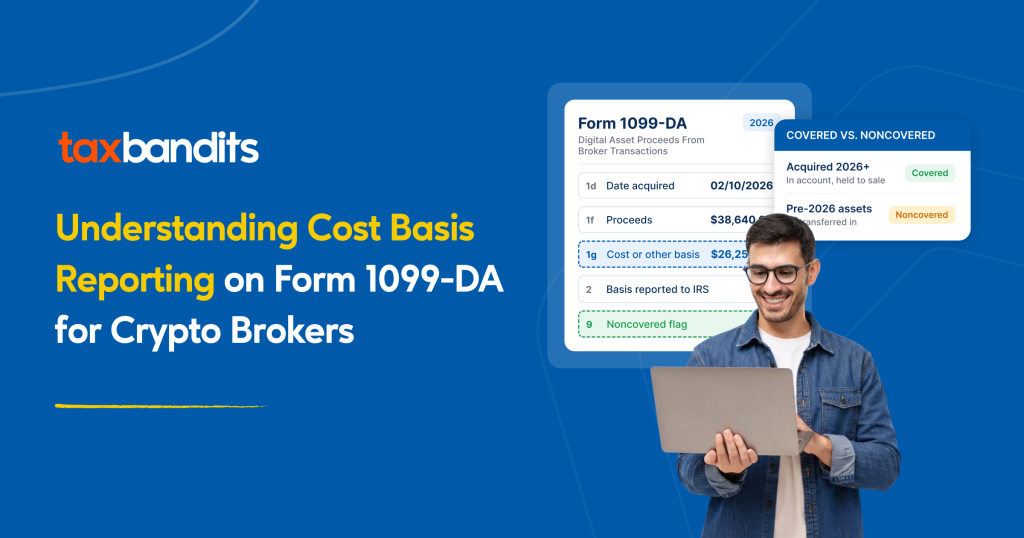
A covered digital asset is one acquired on or after January 1, 2026, through a customer’s account at a broker that provides custodial services, and held in that account until sale. The broker must report the acquisition date and basis.
A noncovered digital asset is any asset that isn’t covered. That includes assets acquired before 2026 and assets transferred in from an external wallet or another platform. Brokers aren’t required to report basis for these, but they may do so voluntarily.
Good to know: If you report basis voluntarily for a noncovered asset, checking Box 9 (noncovered security) is what preserves your penalty relief for that figure. |
Sales reported under the optional aggregate method for qualifying stablecoins and specified NFTs are also exempt from basis reporting.
Key Form 1099-DA boxes for basis reporting
| Box | What it reports | What to watch |
| 1d | Date acquired | Can be blank for noncovered assets or units acquired on multiple dates |
| 1f | Proceeds | Reduced by transaction costs such as fees and commissions |
| 1g | Cost or other basis | Includes applicable transaction costs |
| 2 | Basis reported to IRS | Confirm it matches what you reported in Box 1g |
| 8 | Customer-provided acquisition information | Check when you relied on information from the customer |
| 9 | Noncovered security | Don’t check it if any unit in the sale is covered |
| 12a, 12b | Units transferred in and transfer-in date | Leave 12b blank if units arrived on various dates |
Crypto broker readiness checklist for 2026
Review the key areas brokers should address before issuing Form 1099-DA.
1. Classify Covered and Noncovered Digital Assets
Start by identifying which digital assets qualify as covered or noncovered securities under the IRS rules:
- Review the acquisition date of each digital asset.
- Identify assets acquired through the broker’s custodial services after December 31, 2025.
- Flag assets acquired before 2026 or transferred into the broker’s account as noncovered.
- Configure reporting systems to apply the correct basis reporting requirements to each category.
This classification is important because brokers must report cost basis for covered assets, but reporting is voluntary for noncovered assets.
2. Review and Validate Acquisition Records
Accurate acquisition records are essential for calculating and reporting cost basis, meaning brokers should:
- Maintain acquisition dates, quantities, and purchase prices for covered digital assets.
- Collect relevant acquisition information when customers transfer assets into their accounts.
- Identify missing or inconsistent transaction records.
- Establish a process to review customer-provided acquisition information and supporting records.
Reliable acquisition data helps determine the correct basis when customers sell or dispose of their digital assets.
3. Establish a Cost Basis Calculation Process
A consistent, reliable process for calculating the cost basis of covered digital assets is critical. To prevent incorrect basis reporting.
An ideal process includes the following checks:
- Determine the cost basis for each acquired digital asset unit.
- Account for applicable transaction costs when calculating basis.
- Maintain separate acquisition lots to track assets purchased at different times and prices.
- Support specific identification of the digital asset units sold.
- Apply the applicable default lot-selection method when customers do not adequately identify the units being disposed of.
4. Prepare for Transfers and Partial Dispositions
Digital assets transferred from external wallets or other platforms require extra attention because the receiving broker may not have the original acquisition information.
- Track the number of digital asset units transferred into customer accounts.
- Record the transfer-in date and retain available acquisition information.
- Distinguish transferred assets from assets acquired through the broker’s custodial services.
- Ensure partial sales are matched with the correct acquisition lots.
Brokers should also prepare to report applicable transfer details in Box 12a (Number of Units Transferred In) and Box 12b (Transfer-in Date) on Form 1099-DA.
5. Validate Form 1099-DA Reporting Data
Before generating Forms 1099-DA, verify that all required transaction details are accurate by:
- Checking the digital asset code, name, and number of units sold.
- Verifying the acquisition date and sale date.
- Reconciling gross proceeds and cost basis amounts.
- Confirming the basis reporting indicator in Box 2.
- Checking Box 9 when reporting noncovered digital assets.
- Verifying applicable transfer information and other required fields.
These checks help ensure that covered and noncovered digital asset transactions are reported correctly.
6. Test Reporting Systems Before Filing
Testing reporting systems before filing season helps identify errors early, meaning brokers should:
- Run sample transactions involving covered and noncovered digital assets.
- Test transactions involving multiple acquisition lots and partial sales.
- Check how the system handles transferred assets and missing acquisition information.
- Verify that cost basis calculations and Form 1099-DA fields are populated correctly.
- Review sample forms for reporting inconsistencies before generating customer statements.
Common cost basis reporting challenges brokers should address
Even with reporting systems in place, challenges can arise when tracking digital asset transactions.
Some common issues include:
- Missing acquisition records: Customers may transfer assets from external wallets without complete purchase history, making cost basis calculations difficult.
- Inconsistent transaction data: Differences in transaction records across wallets and exchanges can create reconciliation issues.
- Incorrect asset classification: Misidentifying covered and noncovered digital assets can lead to incorrect basis reporting.
- Lot identification errors: Failure to identify the correct digital asset units sold can result in inaccurate cost basis calculations.
- Calculation discrepancies: Overlooking applicable transaction costs or adjustments can affect reported basis amounts.
Establishing data validation and reconciliation processes to identify these issues before preparing Form 1099-DA is ideal.
Final Thoughts
Preparing for 2026 cost basis reporting requires accurate transaction records, reliable basis calculations, and reporting systems that support Form 1099-DA requirements. By reviewing these areas early, crypto brokers can identify reporting gaps and improve filing accuracy.
TaxBandits helps businesses manage information return filing, including Form 1099-DA. Prepare your digital asset reporting process and get ready for the 2026 filing season.
Leave a Comment