

reading time: 12 minute(s)
Filing your taxes doesn’t always go as planned.
Maybe you’re still waiting on documents. Maybe your numbers aren’t fully ready. Or maybe you just need more time to review everything properly. Instead of rushing and risking mistakes, you have a better option—request an extension.
That’s where Form 4868 comes in.
What Filing Form 4868 Actually Does
Form 4868 is an IRS form used to request an automatic extension of time to file your individual income tax return. When approved, the extension generally gives you an additional six months to file your return.
It is important to note that filing Form 4868 extends the time to file your tax return, but not the time to pay any taxes owed. If you expect to owe taxes, you should estimate and pay the amount due when submitting the extension to avoid penalties and interest.
What You’ll Need Before Filing
Before filing Form 4868, make sure you have the following details ready:
- Your name and address
- Social Security Number (SSN) or Taxpayer Identification Number
- Spouse’s SSN (if filing jointly)
- Estimated total tax liability for the year
- Total payments already made (withholding, estimated payments, or credits)
- Amount you expect to owe, if any
Providing accurate estimates helps reduce the risk of penalties later.
Step-by-Step Instructions to File Form 4868
Form 4868 might look structured, but it’s actually straightforward once you understand what each section is asking for.
Let’s walk through it the way you’d actually fill it out.
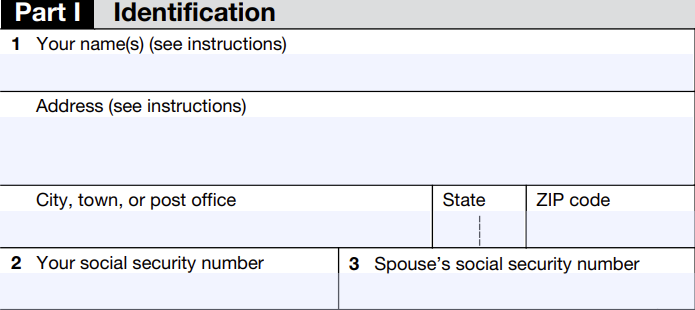
Part I — Identification
At the top of the form, you’re simply identifying yourself.
- Line 1 (Name and Address): Add your name and current address, exactly as they’ll appear on your tax return. If you’re filing jointly, include both names in the same order.
| Note: If your name changed recently, update it with the Social Security Administration before filing to avoid delays. |
- Line 2 (SSN): Enter the Social Security Number that will appear first on your tax return. Estates or trusts filing Form 1040-NR should enter their EIN instead.
- Line 3 (Spouse’s SSN): If it’s a joint return, you’ll also add your spouse’s SSN.
Part II — Individual Income Tax
Now, estimate your taxes. This is where most people pause, but it doesn’t need to be perfect — it just needs to be reasonable.
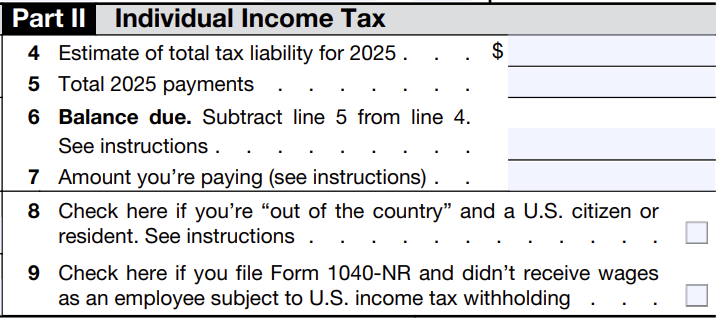
- Line 4 (Estimate of Total Tax Liability): Enter the total tax liability you expect to report on your tax return for the year. This should be based on your estimated income, deductions, and credits. If you expect your tax liability to be zero, enter 0.
Make your estimate as accurate as possible. If the IRS later determines the estimate was not reasonable, your extension request may be invalid.
- Line 5 (Estimate of Total Payments): Next, enter the total payments you’ve already made, such as:
- Withholding from your paycheck
- Estimated tax payments
- Any applicable credits
Do not include the amount you plan to pay with Form 4868 on this line.
- Line 6 (Balance Due): Subtract the total payments (Line 5) from your estimated tax liability (Line 4). If your payments are greater than your estimated tax liability, enter 0.
- Line 7 (Amount You’re Paying): Even though you’re filing an extension, the IRS still expects you to pay what you can. You’ll enter the amount you’re paying with the extension. It doesn’t have to be the full amount — but the closer you get, the more you reduce potential interest and penalties.
Additional Details
At the end of the form, there are a few situational checkboxes.
Line 8 (Out of the Country): Check this box if you are outside the United States on the due date of your tax return. Certain taxpayers living or working abroad may qualify for additional time to file.
Line 9 (Form 1040-NR Filers): Check this box if you are filing Form 1040-NR and did not receive wages subject to U.S. income tax withholding, and your return is due later than the standard deadline.
Simplify Your Form 4868 E-filing with TaxBandits
Running out of time to file your tax return? TaxBandits makes submitting Form 4868 quick and straightforward.
With built-in error checks, instant IRS acknowledgments, and easy status tracking from your dashboard, TaxBandits helps ensure your extension is filed accurately and on time.E-file your Form 4868 with TaxBandits today and get the extra time you need to complete your return confidently.
Leave a Comment