

reading time: 21 minute(s)
Ask any bursar’s office what January looks like, and international students come up fast.
One student wants a 1098-T they aren’t owed. Another received one and has no idea what to do with it. Your office decides which is which, and the IRS instructions leave more room for your judgment than most filers expect.
Fortunately, the rules for 1098-T for international students rely on a single question: is the student a nonresident alien for U.S. tax purposes?
This guide covers who receives a form, who doesn’t, how to handle requests and TINs, and what to record, using the 2026 IRS Instructions for Forms 1098-E and 1098-T.
The baseline rule for filers
An eligible educational institution must report Form 1098-T for each student it enrolls and for whom a reportable transaction is made. In other words, you file for any student enrolled for any academic period during the year, and you decide enrollment under your own rules or use dates the IRS allows, such as 30 days after the first day of the academic period.
However, the IRS provides four exceptions:
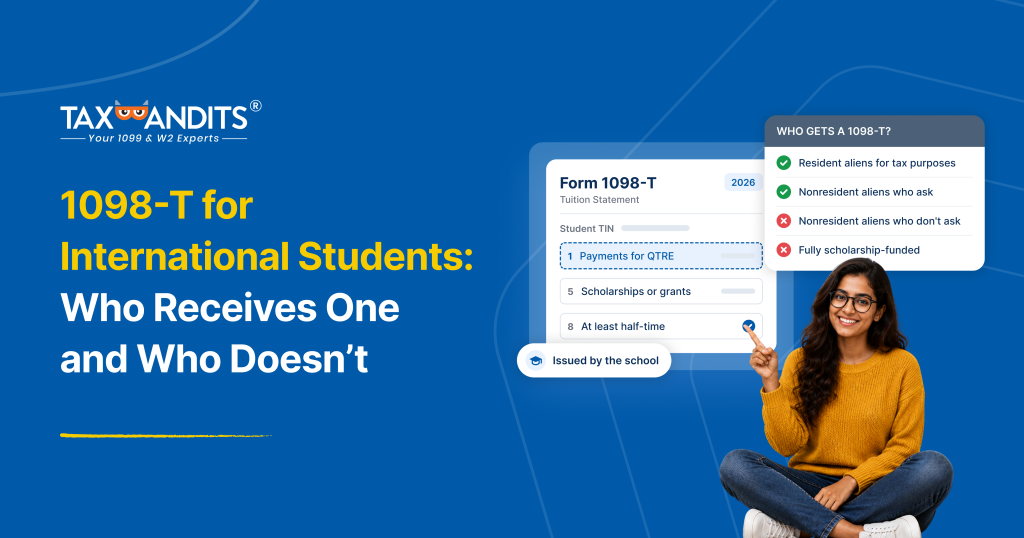
- Nonresident alien students, unless the student requests the form.
- Students whose qualified tuition and related expenses are entirely waived or paid entirely with scholarships.
- Students whose expenses are covered by a formal billing arrangement with an employer or a governmental entity, such as the Department of Veterans Affairs, where you don’t maintain a separate financial account for the student.
Who receives a 1098-T
International students get a form when they aren’t covered by an exception and a reportable transaction occurred.
In practice, that means:
- Resident aliens for tax purposes: A student who has a green card, or who has been in the U.S. long enough to meet the substantial presence test, is treated like any other student. Report these students under their SSN or ITIN.
- Nonresident aliens who request one: The exception only applies when the student doesn’t ask. Once a student requests the form, and a reportable transaction exists, you should file and furnish it.
- Students with partial funding: A scholarship that covers half the bill doesn’t trigger the exception; only full waivers or full scholarship coverage do.
Who doesn’t receive one
You don’t have to file or furnish a form for a nonresident alien student who hasn’t requested it. Many F-1 and J-1 students fall into this group, and the form matters less for them, since nonresident aliens are generally not eligible for the education credits the form supports.
Schools often have separate reporting duties for taxable scholarship or fellowship payments to nonresident aliens, typically on Form 1042-S, so confirm that process is covered as well.
Other international students may be filtered out due to these exceptions:
- A student fully funded by scholarships or a waiver
- A student enrolled only in a noncredit course, such as a language program that awards no academic credit toward a degree or certificate.
- Whether a particular program counts depends on the academic credit definition in the instructions.
How to tell whether a student is a nonresident alien
Residency for tax purposes follows two main tests: the green card test and the substantial presence test.
Two details can cause confusion:
- Visa status isn’t tax status: Students on F, J, M, or Q visas are generally exempt from counting days toward the substantial presence test for a limited period, commonly the first five calendar years. After that, a student can become a resident alien for tax purposes, and the exception stops applying.
- Status can change year to year: A student who was a nonresident last year may not be one this year, so don’t carry the flag forward automatically.
If your school collects status information at enrollment and confirms it annually, always keep records showing how each determination was made because a student’s residency affects your filing requirements.
What to do when a nonresident student requests a form
If a nonresident alien student asks for a 1098-T, the exception no longer applies to that student, and you should:
- Record the request, ideally in writing.
- Confirm a reportable transaction exists, such as qualified tuition and related expenses paid or scholarships processed during the year.
- Solicit the student’s TIN in writing, using Form W-9S or your own form.
- File the form with the IRS and furnish a statement to the student.
You aren’t required to file for nonresident students who don’t ask, so filing for all of them is a policy choice.
If you do file for every student, apply the same TIN solicitation and reporting standards across the board.
TIN and address rules
The TIN box is where international student reporting most often goes wrong.
To avoid errors:
- Enter the student’s TIN as provided on Form W-9S or another form, and check the TIN box when you’ve received the TIN in writing from the recipient.
- You can also check it if you obtained the TIN in a prior year by written solicitation or from a financial aid application, and have no reason to think it’s wrong.
If you have no TIN on record, you can still file with the field blank and check the box, but only if you made a written solicitation on or before December 31 of the year you’re reporting. By checking the box, e-filers certify under penalties of perjury that they followed the IRS standards for soliciting the TIN in good faith.
Note: A student may have an ITIN instead of an SSN, and an ITIN is acceptable.
For the student’s address, enter the permanent address:
- A student’s home or long-term address where they receive forwarded mail
- Use IRS country codes for a foreign address, such as for an international student
Note: You may shorten the student’s TIN on the statement you furnish, but never on the copy you file with the IRS.
Prior-year adjustments for nonresident students
Filed and furnished a Form 1098-T for a nonresident alien in a previous year? Later adjustments connected to that student still follow the Box 4 rules and requires you to report:
- Reimbursements or refunds of amounts reported for a prior year after 2002
- Any reductions in amounts
- Keep in mind a student who requested a form last year may have refunds or reductions this year that you still have to report.
What belongs on the form
For international students who do get a 1098-T, the boxes work the same as for anyone else:
- Box 1: Payments received for qualified tuition and related expenses, not reduced by scholarships.
- Box 5: Scholarships or grants you administered and processed.
- Box 8 and Box 9: Check for at least half-time and graduate students.
Be careful with charges specific to international students. Room, board, insurance, medical expenses including student health fees, and transportation aren’t qualified tuition and related expenses. Mandatory health plan charges, housing deposits, and similar fees don’t go in Box 1.
Mistakes to avoid
- Assuming every international student is a nonresident alien. Students who’ve been in the U.S. for years may be resident aliens for tax purposes.
- Ignoring a student’s request for a form.
- Skipping the TIN solicitation before December 31, which can expose you to penalties.
- Reporting a temporary address when you have a permanent one.
- Including health insurance or housing charges in Box 1.
- Applying the scholarship exception to partial scholarships.
- Forgetting Box 4 adjustments for a nonresident student you reported last year.
Filing Form 1098-T with TaxBandits
International students add judgment calls to an already detailed form: residency status, student requests, TIN solicitation, and foreign addresses all affect what you file.
TaxBandits helps educational institutions prepare and e-file Form 1098-T through a guided process, so you can review student details and box entries before you submit and file corrections when something changes.
Leave a Comment