

Form 5500-EZ vs. Form 5500-SF vs. Form 5500: Which One Should You File in 2026?
reading time: 24 minute(s)
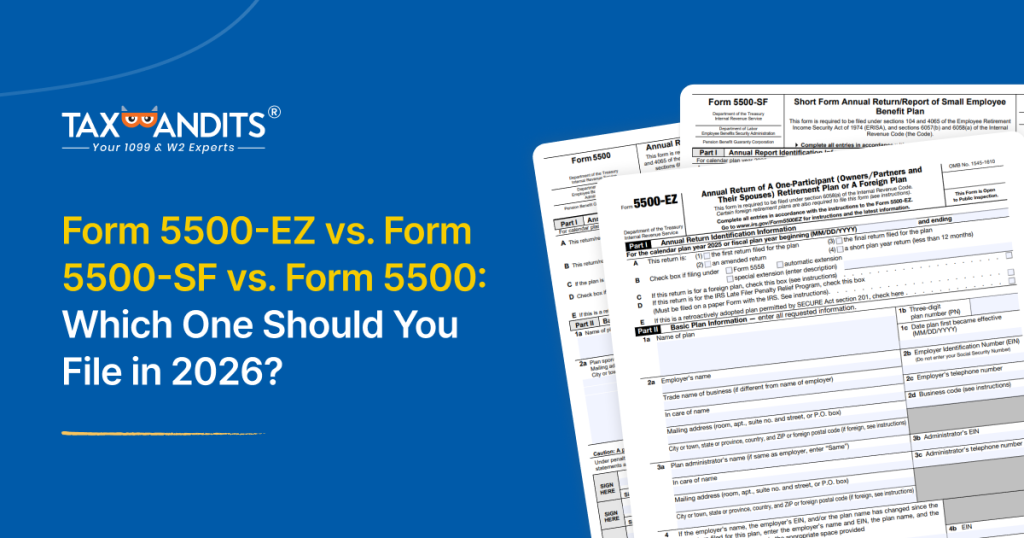
Every summer, the same question shows up in every retirement plan forum: “I got a filing reminder from my TPA, but which Form 5500 do I actually file?” Different plans come with different levels of scrutiny, so picking the wrong one means more than redoing paperwork; it means penalties that start at $10 a day and potentially climb into six figures.
This guide will cover what determines the form you file, recently changed rules, and the mistakes that often show up in DOL enforcement letters.
Key Takeaways
- Form 5500-EZ is for one-participant plans (an owner, or an owner and spouse, or business partners and their spouses) and certain foreign plans. One-participant plans can no longer use Form 5500-SF as of 2021.
- Form 5500-SF is the short form for ERISA-covered small plans, generally fewer than 100 participants, that meet certain conditions (no employer securities, a qualifying institution holds the assets, no hard-to-value investments).
- Form 5500 is the full form for large plans (generally 100+ participants) and for small plans that don’t meet the SF conditions. Large plans generally need an independent auditor’s report.
- Form 5500-EZ filings stay private. Form 5500 and Form 5500-SF are public records, searchable on the DOL’s site.
Form 5500-EZ: The One-Participant Form
This form exists for plans covering only a business owner, an owner and spouse, or partners and their spouses. The IRS calls this a “one-participant plan.” Most people know it as a Solo 401(k), Solo-K, Uni-K, or individual 401(k).
A few things trip people up:
- No automatic filing requirement: If combined plan assets are $250,000 or less at year-end, you generally have no filing obligation. Cross that line, and you must file for that year and every year after, even if the balance later drops. See the Form 5500-EZ filing requirements for more details.
- No exit without a final return: You must file a final Form 5500-EZ in the year you fully terminate the plan and distribute all assets, regardless of balance. Plan owners commonly miss this filing.
- A one-participant plan cannot use Form 5500-SF: This is the single most common mix-up. Before 2021, some solo plan owners filed the short form, but the IRS eliminated that option.
- E-filing is now mandatory for most EZ filers: Filers required to submit at least 10 IRS returns of any kind in a calendar year (counting W-2s, 1099s, and other returns together) must file Form 5500-EZ for plan years beginning on or after January 1, 2024. Paper filing still applies below that threshold, or with an IRS hardship waiver.
- Form 5500-EZ stays private: Unlike Form 5500 and Form 5500-SF, one-participant filings are private.
- Filing starts a three-year clock on the IRS’s ability to reassess taxes or challenge the plan’s qualified status for that year. Without a filed return, that window stays open indefinitely.
Form 5500-SF: The Short Form for Small Plans
To use Form 5500-SF, a plan generally needs to meet all of these:
- Fewer than 100 participants at the start of the plan year (with some flexibility under the 80-120 rule)
- No plan assets in employer securities
- Assets held at a bank, insurance company, or similar qualifying institution
- No investments requiring the “hard to value” schedule
- Not a one-participant or foreign plan
The form folds summarized financial data directly into itself instead of requiring separate schedules, which is what makes it shorter. Keep in mind, the 5500-SF is an ERISA filing, meaning it’s public. Anyone can search the DOL’s database and see plan assets, participant count, and service provider fees.
Form 5500: The Full Form
The full Form 5500 applies when a plan doesn’t qualify for the short form, most often because it has 100 or more participants under the current counting method, or because it holds employer securities, hard-to-value assets, or assets outside a qualifying institution.
Large plans generally must attach an independent auditor’s report along with Schedule H, which is where costs climb fast. That’s why the counting rules below matter so much to plans sitting near the 100-participant line.
What Recently Changed
- The 2023 counting change quietly reduced audit exposure. Before 2023, the 100-participant threshold counted every employee eligible to defer into a 401(k) or 403(b), regardless of whether or not a contribution was made. Starting with the 2023 plan year, only people with an actual account balance count. This was partly meant to offset the SECURE Act’s eligibility rules and inflated participant counts.
- The 80-120 rule still applies, now using the new counting method. If your count falls between 80 and 120 at the start of the plan year and you filed as small last year, you can elect the same category again, letting a plan drift without triggering large-plan status.
- Switching forms isn’t always a choice. A one-participant plan must use Form 5500-EZ. Once a plan grows past that definition, it moves into SF or full Form 5500 territory with all the reporting and audit exposure that comes with it.
- Filing under $250,000 isn’t required, but can be smart. Plan owners can file to create an IRS-acknowledged record of the plan’s existence and compliance, which matters if the plan’s qualified status is ever questioned.
- An e-filing mandate expanded in 2024. The IRS used to allow paper filing of Form 5500-EZ. Now, filers submitting 10 or more IRS returns of any type per year must e-file.
Deadlines and Extensions
All three forms are due July 31 of the following year for calendar-year plans, seven months after year-end. Filing Form 5558 grants an automatic 2.5-month extension to October 15.
Defined benefit plans have an added wrinkle: an enrolled actuary must sign a Schedule SB for the plan year, and in some new-plan situations, a prior-year Schedule SB may also be needed.
File Late or Get it Wrong? What Happens Next?
Form mix-ups can turn expensive.
- DOL penalty (ERISA Section 502(c)(2)): up to $2,739 per day for failing to file a complete and accurate annual report. This amount remains unchanged because a government-wide OMB directive paused the usual inflation adjustment after the 2025 government shutdown disrupted the CPI-U data agencies use to calculate it.
- IRS penalty: up to $250 per day, capped at $150,000 per return, for a late or incomplete filing.
- PBGC penalty: up to $2,739 per day for late premium filings and related reportable-event notices tied to defined benefit plans, also held flat for 2026.
The Delinquent Filer Voluntary Compliance Program (DFVCP) is the safety valve. If you realize you missed a filing and the DOL hasn’t already contacted you about it, you can self-report through DFVCP at a dramatically reduced rate:
| Plan size | Single late filing cap | Multi-year cap (per plan) |
| Small plan (generally under 100 participants) | $750 | $1,500 |
| Large plan (generally 100+ participants) | $2,000 | $4,000 |
The multi-year cap is the detail people miss: even if you’re five years behind, the total penalty for a small plan tops out at $1,500, not $750 per year. That makes DFVCP dramatically cheaper than waiting and hoping the DOL doesn’t notice.
How TaxBandits Handles the Lift
Filing Form 5500-EZ doesn’t have to feel like a compliance project. TaxBandits handles the filing with guided data entry built for one-participant plans, automatic error and threshold checks before anything transmits, and direct e-filing to EFAST2 with instant DOL confirmation. Running behind on the deadline? TaxBandits also supports Form 5558, so requesting your extension takes minutes. E-filing starts at $49 per return, with volume pricing for CPAs and TPAs managing multiple clients.
E-File Form 5500-EZ Now →
Frequently asked questions
- Can a Solo 401(k) file Form 5500-SF instead of Form 5500-EZ?
No. Since 2021, one-participant plans and foreign plans must e-file Form 5500-EZ. Form 5500-SF isn’t an option, even if it was used previously. - Do I have to file anything for my Solo 401(k) if it has less than $250,000 in assets?
Generally no. A one-participant plan with combined assets of $250,000 or less at year-end has no filing requirement unless the plan terminates that year, in which case a final return is required regardless of the balance. - How many participants count as a “large plan” in 2026?
Generally, 100 or more, but since the 2023 plan year, only participants and beneficiaries with an actual account balance at the start of the plan year count, not everyone merely eligible. - What happens if I file the wrong form?
It’s generally treated as an incomplete or improper filing, exposing the plan to the same penalties as not filing at all. Correcting it yourself before the DOL contacts you, potentially through DFVCP, is far less costly than waiting. - How much can the DOL fine a plan for a late Form 5500 in 2026?
Up to $2,739 per day under ERISA Section 502(c)(2), unchanged from 2025 because an OMB directive paused the usual inflation adjustment. - Can I reduce the penalty if I already missed a filing?
Yes, through DFVCP, as long as the DOL hasn’t already sent written notice. Penalties under DFVCP are capped at $750 to $1,500 for small plans and $2,000 to $4,000 for large plans, regardless of how many years you’re catching up on. - Does hiring my first employee change which form I file?
Yes. Once a plan covers someone other than the owner, spouse, or partners and their spouses, it no longer meets the one-participant definition and moves into Form 5500-SF or full Form 5500 territory.
Leave a Comment