

Form 941-X for 2026: Key Changes and What to Know Before Filing Corrections
reading time: 11 minute(s)
Need to correct a previously filed Form 941 in 2026? Before filing Form 941-X, check what has changed. The final 2026 form includes new guidance on qualified tips and overtime withholding, aggregate return filers, and COVID-19 ERC corrections.
Form 941-X is used to correct eligible errors on a previously filed Form 941. Here’s what employers and tax professionals need to know before preparing a correction.
What’s New in Form 941-X for 2026?
The final 2026 Form 941-X includes several updates that employers and tax professionals should understand before filing a correction.
1. Federal Income Tax Withholding on Qualified Tips and Overtime
- Qualified Tips: Deduct up to $25,000 of qualified tips for tax years 2025–2028.
- Qualified Overtime: Deduct up to $12,500, or $25,000 for married couples filing jointly.
- Form W-4: Employers should use updated W-4 information to adjust federal income tax withholding.
- Form 941-X: Prior-year federal income tax withholding errors generally cannot be corrected using Form 941-X.
- Payroll Taxes: Tips and overtime remain generally subject to Social Security and Medicare taxes.
- IRS Guidance: See Pub. 15 and Pub. 15-T for withholding requirements.
2. New Section for Aggregate Return Filers
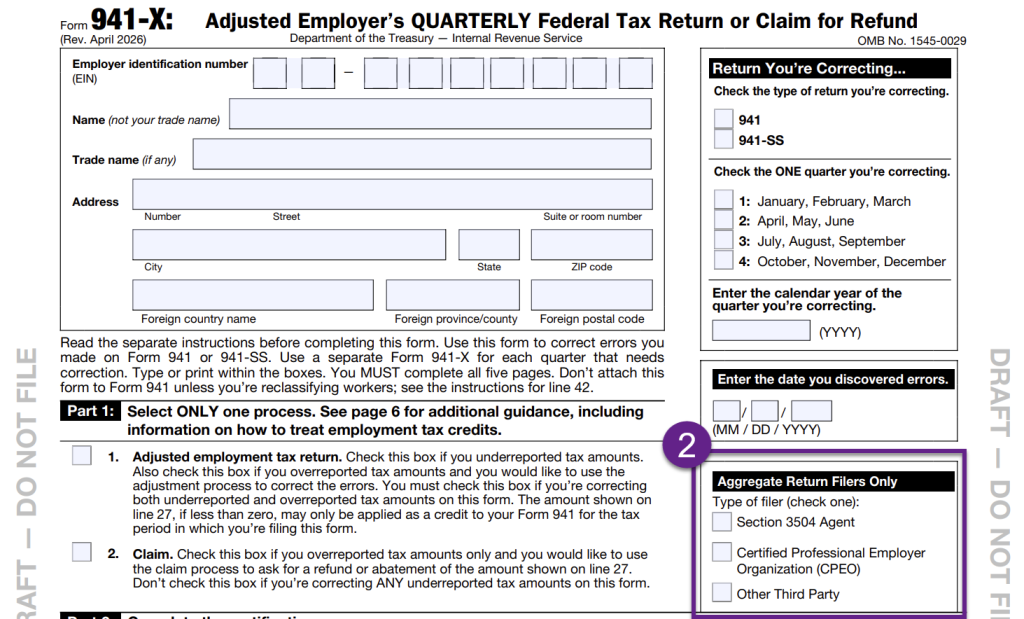
The 2026 Form 941-X adds an Aggregate Return Filers Only section.
Section 3504 agents, Certified Professional Employer Organizations (CPEOs), and other third-party filers must identify their role when filing a corrected aggregate return. Depending on the circumstances, Schedule R (Form 941) may also need to be attached.
This provides the IRS with additional information about who is filing a corrected aggregate return and the employers included in that filing.
3. New Limitations on COVID-19 ERC Corrections
There’s also an important update related to the COVID-19 Employee Retention Credit (ERC).
Under the new law:
- ERC claims for Q3 and Q4 of 2021 are no longer allowed
- Refunds or credits for those quarters are only valid if the claim was filed on or before January 31, 2024
Extended Audit Period
The IRS now has more time to assess ERC claims for those quarters:
- The assessment period is extended to 6 years
- Employers should keep ERC-related records for at least 7 years
If you’re considering filing a 941-X related to ERC for the late 2021 quarters, this change is especially important.
Looking for the latest Form 941 for 2026 updates?
Refer to our detailed article covering the key changes, what’s new, and what employers need to know.
Other Important 2026 Form 941-X Updates
The 2026 instructions also state that several Form 941-X lines are reserved for future use because the period of limitations for correcting those items has generally expired for most employers. These include lines 18a, 26a, 30, 31a, 31b, and 32.
The IRS also confirms that Form 941-X can be filed electronically using the Modernized e-File (MeF) system, and encourages electronic filing.
What Should You Know Before Filing Form 941-X?
Before preparing a correction, review:
- The tax year and quarter being corrected.
- Whether the error resulted in underreported or overreported tax.
- The applicable period of limitations.
- Whether special withholding, aggregate filer, or ERC rules apply.
- The current April 2026 Form 941-X instructions and the instructions for the original Form 941 being corrected.
Keeping the original return and supporting payroll records available can also help ensure the corrected amounts and explanations are accurate.
Final Thoughts
The 2026 Form 941-X provides updated requirements for correcting employment tax returns, with particular attention to withholding on qualified tips and overtime, aggregate return filers, and COVID-19 ERC corrections. Understanding these changes before filing can help employers and tax professionals determine whether a correction is allowed, what information is required, and which filing process applies.
The takeaway is simple: the more you know now, the smoother things will be later. Staying informed, keeping solid records, and understanding what can and can’t be corrected will help you handle payroll fixes with confidence — and avoid surprises you definitely don’t want.
Leave a Comment