

Trump Account Employer Contributions: What Employers Can Give and How to Report It
reading time: 24 minute(s)
An employee is ecstatic to share that their newborn’s Trump Account just received the government’s $1,000! You’re happy for them, but then the question comes: “Can the company also add to the account?”
You love this generous idea, but it depends on the paperwork needed before the first dollar goes out.
After all, Trump Account employer contributions can be tax-free to the employee, but only when made through a written program that meets specific rules.
Let’s look at what this entails under Section 128 of the Internal Revenue Code and the proposed regulations the IRS published in August 2026.
What employers can contribute
Section 128 lets an employer contribute to an employee’s Trump Account, or to the Trump Account of any employee’s dependent, and the employee can exclude the contribution from gross income.
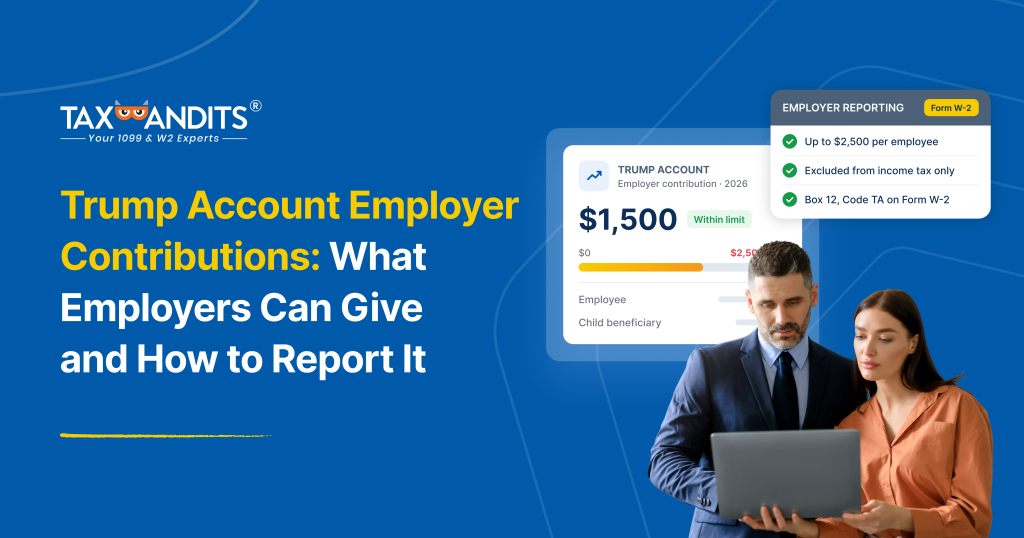
The annual cap is $2,500 per employee, indexed for inflation after 2027; the rules apply to taxable years beginning after December 31, 2025, and contributions to Trump Accounts were allowed starting July 4, 2026.
A few details shape how you structure the benefit:
- The limit is per employee, not per child: An employee with three dependents still has one $2,500 exclusion. You can split it among their accounts, but the total can’t exceed the cap.
- The limit follows the employee across employers: If two employers each contribute $2,500 for the same person, only $2,500 total is excludable. Each employer is fine as long as its own plan caps contributions at the limit.
- Contributions count toward the $5,000 annual limit on Trump Account contributions. You aren’t responsible for tracking that limit.
- The beneficiary must be in the growth period, which runs until December 31 of the year the child turns 17.
- Self-employed individuals can’t participate: Sole proprietors, partners, and 2% S corporation shareholders aren’t employees for this purpose, although they can sponsor a program for their staff.
The written program requirement
The exclusion only applies to contributions made under a Trump Account contribution program, which is a separate written plan for the exclusive benefit of your employees.
Under the proposed regulations, the plan document must specify:
- Which classes of employees are eligible
- The contribution rules, including amounts and whether employees can fund contributions through a cafeteria plan
- How employees designate the account
- The certification, notice, and reporting procedures
- The plan year
- How you’ll correct administrative failures and notify trustees when an amount turns out not to qualify
You also must follow the plan as written and give eligible employees reasonable notice of the program and its terms.
Note: Many employers are considering matching the government’s $1,000 pilot contribution for children born from 2025 through 2028. That can qualify if it’s run through a compliant program, and the proposed regulations include a nondiscrimination safe harbor for it, covered below.
Verifying accounts and certifications
Before you send money, you need to know it’s going to an eligible Trump Account by using a two-part check:
- Employee certification: You may rely on a written statement from the employee stating the beneficiary’s relationship, date of birth, and confirming they know of nothing that would make the account ineligible. You can rely on it unless you have actual knowledge it’s wrong.
- Account verification: A certification alone isn’t enough. You need a method reasonably designed to confirm the destination is a valid Trump Account, using information from the trustee, your payroll processor, or another service provider.
You can’t limit contributions to one trustee or a short list of trustees. Because each child can have only one Trump Account, restricting the trustee could shut an employee out of the benefit for their own child.
Communicating with the trustee
When you make a contribution, tell the trustee in writing that it’s a Section 128 contribution. The trustee can rely on that label until it receives a correction or has contrary knowledge.
If you later determine that an amount didn’t qualify, either in whole or in part, you must send a corrective notice to the trustee. It should include the affected account information, the calendar year of the contribution, and the amount that didn’t qualify. The proposed rules treat 21 calendar days after your determination as a reasonable time, so build that deadline into your process.
Payroll tax treatment
This is the part that surprises payroll teams; the exclusion is for federal income tax only:
- Income tax: Qualifying contributions are excluded from the employee’s gross income.
- Federal income tax withholding: You don’t withhold on qualifying contributions.
- FICA and FUTA: No exclusion applies, so the contributions are still wages for Social Security, Medicare, and unemployment tax purposes unless another exclusion fits.
Contributions that don’t qualify are different. If you contribute more than the limit, or contribute outside the program, the extra amount is generally includible in the employee’s gross income and wages, and it’s subject to ordinary employment tax reporting and withholding.
For example, if the program allows $2,500 and you contribute an extra $1,000 outside it, treat that $1,000 as taxable compensation.
Using a cafeteria plan
Employees can fund contributions by salary reduction under a Section 125 cafeteria plan, but only for a dependent’s Trump Account. A salary-reduction contribution to the employee’s own account isn’t allowed, because it would amount to prohibited deferred compensation.
Under the proposed rules, the cafeteria plan must specifically describe the benefit and let employees prospectively change or revoke their elections at least monthly, before the salary becomes available.
Nondiscrimination rules
Section 128 borrows several nondiscrimination requirements from the dependent care rules in Section 129. In short, the program can’t favor highly compensated employees:
- Contributions and benefits: The program has to offer the same terms to eligible HCEs and non-HCEs, even if actual amounts differ because of employee elections.
- Eligibility: The eligible group must be a reasonable, objectively defined classification, such as job category or location, and can’t be a list of named employees. It passes a numerical safe harbor if the share of eligible non-HCEs is at least 90% of the share of eligible HCEs, reduced by three-quarters of a point for each whole point that non-HCEs exceed 60% of the workforce.
- Average benefits: Average benefits for non-HCEs must be at least 55% of those for HCEs.
Employees under 21 with less than a year of service, and certain collectively bargained employees, are generally excluded from testing. A failure doesn’t wipe out the exclusion for everyone. Rank-and-file employees keep it, while HCEs lose it. For certain average benefits failures, you can fix the problem by including the excess in the affected HCEs’ income by the Form W-2 deadline.
A separate safe harbor covers matching the government’s pilot contribution, as long as you offer it on the same terms to all non-excluded employees. It’s disregarded for the contributions-and-benefits and average-benefits tests, but not for eligibility.
How to report on Form W-2
For 2026, report Section 128 contributions in Box 12 with code TA. The amount covers contributions made to the Trump Account of an employee or the employee’s dependent.
Reporting it there also satisfies the requirement to give employees a written statement of contributions by January 31 of the following year. When January 31 falls on a weekend, the due date moves to the next business day.
Because the exclusion is limited to income tax, the amount should stay out of Box 1 but still be part of the wages shown for Social Security and Medicare.
Status of the rules
The IRS published the proposed regulations in August 2026, and the comment period and public hearing have since taken place. They would apply to plan years beginning on or after the date final regulations are published, and employers may rely on the proposed rules in the meantime. Watch for final regulations before you finalize plan terms.
Mistakes to avoid
- Contributing without a written program, which makes the amount taxable.
- Treating the limit as per child, when it’s per employee.
- Relying on the employee’s certification alone without verifying the account.
- Restricting contributions to one trustee.
- Missing the corrective notice when a contribution doesn’t qualify.
- Leaving Code TA off the W-2.
Filing Form W-2 with TaxBandits
Trump Account contributions add a new reporting line to an already busy year-end, and each amount has to land in the right box.
TaxBandits helps employers prepare and e-file Form W-2 through a guided process, so you can review wage and Box 12 entries before you submit and file corrections if something changes. Get started with TaxBandits to e-file your Form W-2.
Leave a Comment