

reading time: 15 minute(s)
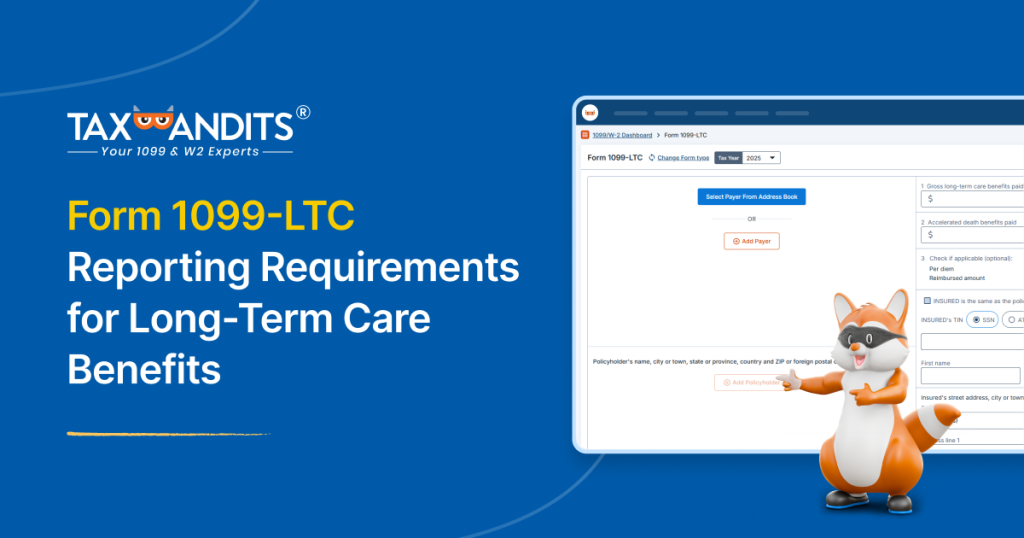
If you’re an insurance company, governmental unit, or viatical settlement provider paying long-term care benefits, Form 1099-LTC is your reporting responsibility, and getting it right matters.
Form 1099-LTC is an IRS informational return used to report long-term care insurance benefits and accelerated death benefits paid to policyholders. It doesn’t determine whether those payments are taxable, but the accuracy of what you report directly shapes how recipients and their tax professionals handle the tax side.
This guide walks you through everything you need to know: who you’re filing for, what you’re reporting, and the deadlines.
Are you required to file Form 1099-LTC?
You are required to file Form 1099-LTC if you fall into any of the following categories:
- Insurance companies pay benefits under a long-term care insurance contract.
- Federal, state, or local government units making equivalent payments.
- Viatical settlement providers are paying accelerated death benefits.
Filing is only triggered when:
- The policyholder is an individual; if the policyholder is a corporation or other non-individual entity, you are not required to file.
A payment becomes reportable when it is made for:
- Nursing home care, home health services, or other qualifying long-term care services under a qualified or non-qualified long-term care insurance contract.
- Accelerated death benefits are paid to a policyholder who is chronically or terminally ill.
Who are the parties you’re reporting for?
When you file Form 1099-LTC, you are reporting for two distinct parties, and correctly identifying each one is critical to accurate filing.
Policyholder
- The individual who owns the long-term care insurance contract.
- This is the person whose Social Security Number (SSN) or TIN you report on the form.
Insured
- The individual who is chronically or terminally ill and receiving care.
- The insured may or may not be the same person as the policyholder.
Why this distinction matters:
- The IRS definitions of chronically ill and terminally ill directly determine what you report and which boxes you complete.
- A chronically ill individual must be certified by a licensed healthcare practitioner as unable to perform at least 2 activities of daily living or requiring substantial supervision due to cognitive impairment.
- A terminally ill individual is certified by a physician as having an illness expected to result in death within 24 months.
Getting this classification right on your end ensures the recipient’s tax treatment is handled correctly downstream.
What you’re required to report
Form 1099-LTC captures two broad categories of payments you are obligated to report:
1. Long-Term Care Insurance Benefits
- Payments from a long-term care insurance policy that cover eligible care services, including nursing home care, assisted living, or in-home health support.
- These are reported as either reimbursed amounts or per diem payments, and this distinction is one of the most important things you need to get right.
2. Accelerated Death Benefits
- Payments made to a policyholder who is chronically or terminally ill, drawn against a life insurance policy’s death benefit.
- These must be reported regardless of whether the underlying contract is qualified or non-qualified.
Qualified long-term care insurance contract:
- You are also required to indicate whether the contract under which you made payments is a qualified long-term care insurance contract.
- This affects how the recipient and their tax professional determine the taxability of benefits received.
Accurate reporting on these two fronts, payment type and contract qualification, is where most filing errors occur, so double-check both before submitting.
Tax treatment—What you need to know
Your role is to report accurately; determining whether the benefits are taxable is the recipient’s responsibility, not yours. Recipients use Form 8853, Section C, to calculate any taxable portion.
That said, understanding the tax treatment helps you report with precision:
Reimbursed Amounts (Qualified Contract)
- Generally excludable from the recipient’s income as long as payments don’t exceed actual long-term care expenses incurred.
Per Diem Payments (Qualified Contract)
- Excludable up to the IRS-prescribed daily limit, which is reviewed and updated annually.
- Any amount paid above this limit may be taxable to the recipient.
Accelerated Death Benefits
- Payments made to a terminally ill individual are fully excludable from income.
- Payments made to a chronically ill individual follow the same rules as LTC benefits above.
Non-Qualified Contracts
- Benefits may be partially or fully taxable depending on the contract terms.
- Recipients and their tax professionals will need additional documentation from you to determine the taxable portion.
Your filing deadlines & compliance obligations
Meeting your filing deadlines is non-negotiable. Here’s what you need to keep in mind:
Filing Deadlines
- Paper filing: February 28
- Electronic filing: March 31
- If you are filing 10 or more returns, e-filing is mandatory
Penalties for Non-Compliance
- Penalties are tiered based on how late the filing is; the longer you wait, the higher the penalty.
- Incorrect or incomplete returns can also attract penalties, even if filed on time.
Wrapping up
Form 1099-LTC is more than a compliance checkbox; it’s a critical piece of information that recipients and their tax professionals rely on to handle their tax obligations correctly.
Since IRS thresholds and requirements can change from year to year, make it a habit to review the latest IRS instructions for Form 1099-LTC before filing.
Accurate reporting on your end sets the entire process up for success, for you, and for the recipient.
Leave a Comment