

reading time: 14 minute(s)
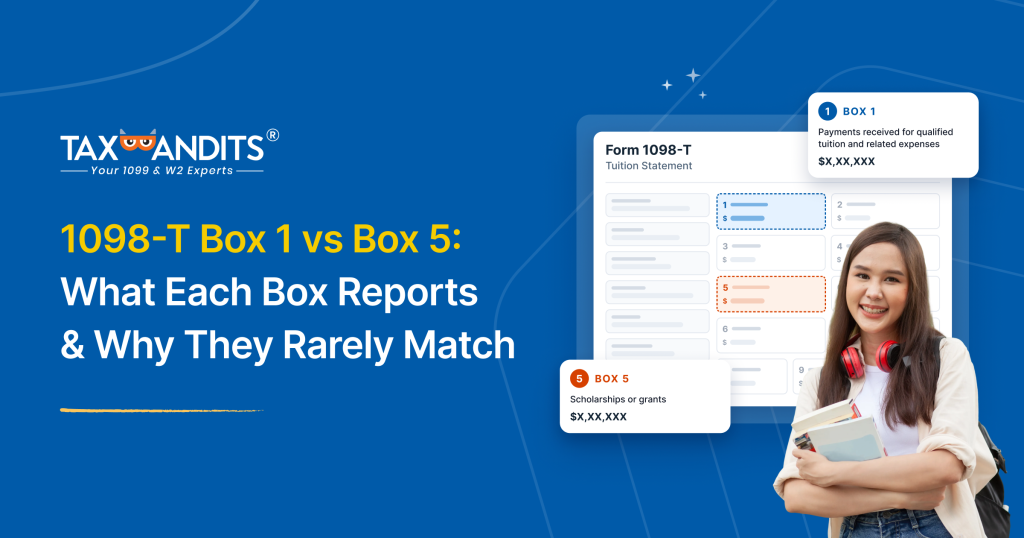
A student opens her 1098-T, and the numbers don’t look right. Box 1 shows $20,000. Box 5 shows $12,000. She wonders whether the scholarship was already subtracted, whether the two numbers should add up to something, and whether she owes tax. So she emails the bursar’s office.
Her form is probably correct. It just doesn’t tell the same story as the tuition bill. Once you know what each box measures, the mismatch makes sense, and so does the answer you give her.
What’s the difference between Box 1 and Box 5 in Form 1098-T?
Box 1 and Box 5 report two different things.
- Box 1: payments the school received for qualified tuition and related expenses (QTRE) during the calendar year
- Box 5: scholarships and grants the school administered and processed during the calendar year
Learn more about 1098-T reporting
What Box 1 reports
Box 1 shows the payments the school received for QTRE during the calendar year, minus any refunds made that year that relate to those payments. Since 2018, it reports payments received, not amounts billed.
Included:
- Tuition and required fees paid during the year
- Payments from the student, family members, and loan proceeds
- Past-due QTRE from an earlier year that was paid this year
Not included:
- Charges billed but not yet paid
- Room, board, and optional charges
- Amounts refunded in the same year (these reduce the total)
What Box 5 reports
Box 5 shows the total of scholarships and grants processed by the school during the calendar year. This generally includes payments from third parties, such as government agencies and nonprofits, but not payments from family members or loan proceeds.
Included:
- Scholarships and grants the school administers
- Third-party payments processed through the school
- Aid applied to costs that aren’t QTRE, such as housing
Not included:
- Outside scholarships paid directly to the student, without passing through the school
- Loan proceeds and family payments
Box 1 vs Box 5 at a glance
| Box 1 | Box 5 | |
| What it reports | Payments received for QTRE | Scholarships and grants processed |
| Basis | Cash received in the calendar year | Aid the school administered |
| Prior-year corrections | Box 4 | Box 6 |
| Netted against the other? | No | No |
Why the two rarely line up
- They count different things. One tracks money received and the other tracks aid processed. Neither is the tuition bill.
- Calendar years cut across semesters. Spring tuition paid in December lands in the earlier year. That is what Box 7 is for.
- Aid can cover more than tuition. A scholarship applied to housing raises Box 5 without touching Box 1, so Box 5 can end up larger.
- Adjustments arrive late. Same-year refunds reduce Box 1, while changes to earlier years go through Boxes 4 and 6.
- Outside awards are invisible to the school. A scholarship paid directly to the student never reaches Box 5.
Box 1 vs. Box 5 in Practice
A student is billed $10,000 per semester in tuition and required fees. She pays fall in August and spring in December. The school also processes a $12,000 scholarship during the year, part of which goes toward housing.
| Box | Amount | Why |
| Box 1 | $20,000 | Both semesters were paid during the calendar year |
| Box 5 | $12,000 | Scholarship processed by the school |
| Box 7 | Checked | Spring was paid before the term began |
The two figures don’t combine into any single bill, and the form doesn’t say what, if anything, is taxable.
What students do with these numbers
Neither box answers the tax question. Students compare their scholarships against their qualified expenses. In general:
- Scholarship money used for tuition, required fees, and required course materials is tax-free for a degree candidate
- Amounts used for room, board, or travel are generally taxable, as are amounts for students who aren’t degree candidates
- Scholarships reduce the expenses that count toward an education credit
- In some cases, a student can choose to treat part of a scholarship as taxable to increase a credit
A tax professional can help with the details, since the right answer depends on the student’s situation.
How schools can keep the form clean
- Reconcile Box 1 to the student-account ledger by calendar year
- Keep Box 5 out of Box 1. Never net one against the other
- Check Box 7 for payments tied to the next academic period
- Use Boxes 4 and 6 for earlier-year changes, not edits to old forms
- Compare Box 5 with financial aid disbursement records before filing
File your 1098-T with confidence
Reconciling payments and aid by hand invites mistakes. TaxBandits helps schools organize student data, validate forms, and e-file with confidence.
Frequently asked questions
Which amount should a student use to claim an education credit?
The amount the student actually paid in qualified expenses, which may differ from Box 1. Box 1 is a starting point, not the final answer.
Do student loans count in Box 1?
Yes. Loan proceeds used to pay tuition count as payments received, not as scholarships.
What if a student thinks Box 1 or Box 5 is wrong?
They should ask the school’s bursar’s office for a review and keep their payment records. If the form is wrong, the school issues a corrected one.
Does a student whose scholarship covers everything get a form?
Generally not. A school is not required to issue a 1098-T when scholarships or waivers cover QTRE entirely.
Leave a Comment