

IRS Changes to 1099 Forms for Tax Year 2025: Everything You Should Know
reading time: 21 minute(s)
Each year brings small adjustments to tax reporting, and most go unnoticed—until they directly change how you file.
For 2025, the IRS has made a few focused updates to key 1099 forms. Some reporting boxes have shifted, a few codes have been added, and certain payment types are now assigned to different forms altogether.
TaxBandits is committed to ensuring you’re up to date on your filing needs, so let’s dive into what’s new for the 2025 Tax Year!
What’s new in 1099 forms for the 2025 tax year?
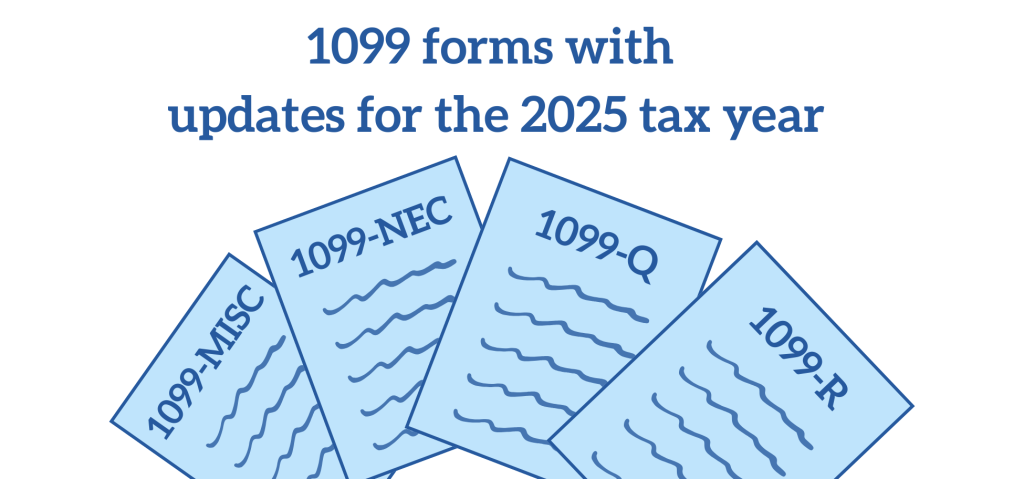
To avoid the headache of IRS complications, it’s crucial to understand the new updates to the 1099 series. This section provides a detailed overview of the IRS changes to various 1099 forms for the 2025 tax year, including updates to reporting boxes, new transfer types, and additional distribution codes. Understanding these updates will help you ensure accurate and compliant tax filings.
1. Form 1099-MISC: Box 14 now reserved for future use
Previously, Box 14 was used to report excess golden parachute payments (large severance payments made to certain executives). However, starting in 2025, this box has been reassigned as “Reserved for future use.”
This means you will no longer report excess golden parachute payments on Form 1099-MISC.
2. Form 1099-NEC: Box 3 assigned for excess golden parachute payments
The previously unused Box 3 on the 1099-NEC form is now designated for reporting excess golden parachute payments.
- If you are issuing large severance or termination payments to executives that meet the IRS definition of “excess golden parachute payments,” these must now be reported in Box 3 of Form 1099-NEC.
- This shift aligns with the purpose of Form 1099-NEC, which focuses on nonemployee compensation and related income types.
| What are excess golden parachute payments? According to the IRS (under IRC § 280G), an excess parachute payment occurs when a company pays a disqualified individual, typically a high-level executive, a large sum of money that is: a delegation of a change in ownership or control of the company (such as a merger, acquisition, or sale of substantial assets), and the total present value of those payments equals or exceeds three times the individual’s “base amount.” The base amount is defined as the individual’s average annual compensation, includible in gross income, for services performed over the five most recent taxable years preceding the change in ownership or control. |
3. Form 1099-K: Original Reporting Thresholds Reinstated
There’s an important update for payments made through third-party platforms such as PayPal, Venmo, and Stripe. The IRS has reversed the previously planned reduction of the 1099-K reporting threshold to $600.
Starting with the 2024 tax year and beyond, the original thresholds remain—a Form 1099-K will only be required if total payments exceed $20,000 and there are more than 200 transactions in a year.
This update eliminates confusion for individuals and small businesses, keeping reporting requirements clear and consistent.
4. Form 1099-DA: New Form for Digital Assets
The IRS has introduced a new information return, Form 1099-DA, to report digital asset transactions. Starting with the 2025 tax year, brokers such as crypto exchanges, payment processors, and hosted wallet providers must issue this form to report gross proceeds from the sale or exchange of digital assets.
Beginning in 2026, they will also be required to include the cost basis and report any resulting gains or losses. This change helps both taxpayers and the IRS maintain more accurate records of digital asset activity.
5. Form 1099-Q: Revised boxes for type of transfer and source of distribution
The IRS has updated Form 1099-Q, which reports distributions from Qualified Education Programs (under sections 529 and 530).
- Box 4a-4b (Type of transfer): This box has been revised to indicate the type of trustee-to-trustee transfer made from the education account. You’ll now select:
- 4a: If the distribution was a trustee-to-trustee transfer between qualified tuition programs (QTPs), to another Coverdell ESA, or from a QTP to an ABLE account.
- 4b: If the distribution was transferred directly from a QTP to a Roth IRA for the benefit of the account beneficiary.
Note: If you don’t have clear documentation that a Coverdell ESA distribution was a trustee-to-trustee transfer, leave Box 4a blank.
- Box 5a-5c (Source of distribution): The IRS has also revised Box 5 to specify the source of the distribution. Now you must choose:
- 5a: If it’s from a private QTP, established by one or more eligible private educational institutions.
- 5b: If it’s from a state-sponsored QTP.
- 5c: If it’s from a Coverdell ESA.
6. Form 1099-R: New distribution codes for qualified charitable distributions (QCDs)
Form 1099-R, used to report distributions from retirement accounts such as IRAs, pensions, and annuities, now includes three new distribution codes in Box 7, relating to Qualified Charitable Distributions (QCDs).
- Code Y + Code 7: To report that QCD is from a non-inherited IRA (normal distribution)
- Code Y + Code 4: To report that QCD is from an inherited IRA (death distribution)
- Code Y + Code K: To report that QCD is from traditional IRA assets that do not have a readily available fair market value (FMV), whether from a non-inherited or inherited IRA.
| What is a Qualified Charitable Distribution (QCD)? A Qualified Charitable Distribution (QCD) is a tax-free donation made directly from your IRA to a qualified charity by your IRA trustee. For more details, see Qualified charitable distributions (QCDs) in IRS Publication 590-B. |
How to prepare for these 1099 changes?
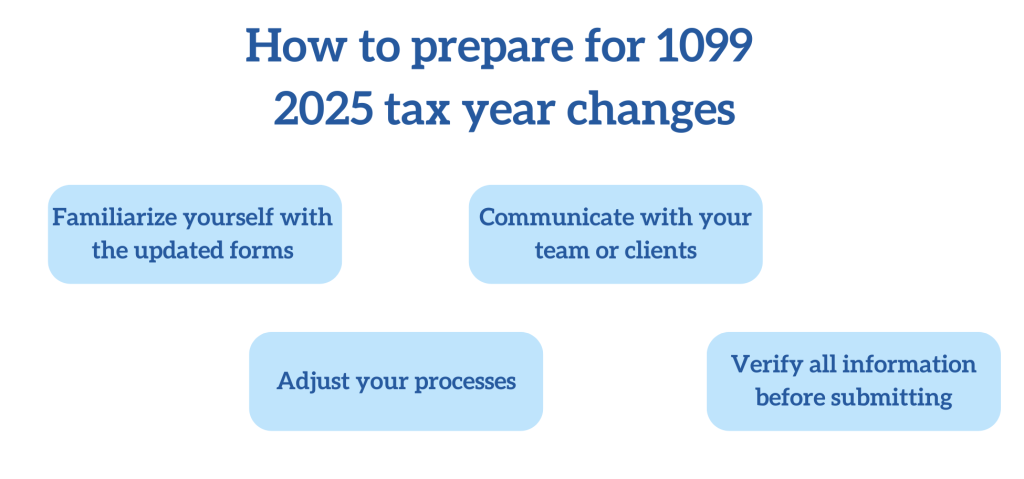
As these IRS updates take effect for the 2025 tax year, here’s how you can get ready:
- Familiarize yourself with the updated forms: Review the latest versions of the 1099 forms you regularly file to understand what has changed and where.
- Adjust your processes: Update your internal workflows, checklists, and templates to reflect any new boxes, codes, or reporting requirements that have been introduced.
- Communicate with your team or clients: Ensure that everyone involved in tax reporting is aware of the changes and understands how they will affect this year’s filing.
- Verify all information before submitting: Double-check the accuracy of form entries, especially new or updated codes, to avoid delays or corrections from the IRS.
Read More: Form 1099 for 2025: The Ultimate Guide for First-Time Filers
Why these changes matter?
The IRS updates these forms to reflect new tax laws, improve clarity, and enhance the accuracy of reporting. When you understand and apply these changes correctly, you:
- Avoid costly errors and penalties caused by incorrect or incomplete filings.
- Ensure a smoother filing process of your returns with the IRS, reducing the chance of audits or follow-up notices.
- Keep your business or clients compliant with the latest tax regulations, building trust and confidence.
- Save time by adapting your processes early, rather than scrambling during tax season.
Conclusion
Staying updated with the latest IRS changes to 1099 forms is essential for accurate and compliant filing, especially as reporting rules continue to evolve. Whether you’re dealing with golden parachute payments, education savings distributions, or retirement plan distributions, these updates for the 2025 tax year are designed to improve reporting clarity.
With the proper knowledge and e-filing solution, you can adapt easily and avoid filing mistakes. That’s where TaxBandits comes in.
TaxBandits handles the updates, the compliance, and the complexity—so you can focus on what matters most. From using the latest IRS 1099 forms to validating your filings and delivering recipient copies securely, TaxBandits manages it all in one place, so you don’t have to worry about compliance and can rest easy knowing we will support your filing process from start to finish.
Leave a Comment