

FIRE to IRIS Transition: What to Know Before the IRS Retires the Legacy System in 2027
reading time: 25 minute(s)

After decades of handling information returns through the Filing Information Returns Electronically (FIRE) system, the IRS is officially set to retire the platform. Starting with tax year 2026 (filed in 2027), the Information Returns Intake System (IRIS) will become the sole method for electronically submitting forms like 1099, 1098, 1042-S, and 5498.
This marks one of the most significant shifts in IRS filing infrastructure in over 40 years. For businesses, tax professionals, and software providers, this change isn’t just technical—it affects filing formats, submission processes, and compliance timelines.
Here’s everything you need to know about the transition—and how to get ahead of it.
What is IRIS? A Modern Filing System for the Future
IRIS is the IRS’s new electronic filing platform, developed to replace the aging FIRE system. While FIRE has been in use since the 1980s, it was never built to support today’s data volume, real-time validation needs, or modern integration standards.
IRIS was officially launched in January 2023 as part of a phased rollout. Initially, it supported only a limited set of Form 1099s through the IRS’s web-based portal, but it has since expanded to support more filing types and now includes a robust Application-to-Application (A2A) API for high-volume filers.
IRIS is not just a new portal—it’s an entirely different filing ecosystem that uses structured XML data, introduces real-time feedback mechanisms, and enables automation through secure APIs. It’s central to the IRS’s broader efforts to modernize how information returns are submitted and processed.
With IRIS, the IRS aims to:
- Improve data accuracy through standardized, schema-driven filings
- Support small and large filers with flexible filing methods
- Deliver faster acknowledgments and error detection
- Create a scalable infrastructure that can support future expansion
The system is already live and gaining adoption, and by January 2027, it will be the only way to e-file these information returns with the IRS.
FIRE vs. IRIS: A Quick Comparison
| Feature | FIRE System | IRIS System |
| Launch Year | 1986 | Rolled out in phases (2023–2027 full adoption) |
| File Format | Flat file (1220 format) | XML-based (tagged and structured) |
| Submission Options | FIRE Portal only | Web Portal (for small filers) and A2A API (for large filers) |
| Corrections Process | Corrections filed in 1220 format | Corrections use the Unique Record ID in XML |
| Validation | Limited checks at upload | Schema-based validation with real-time error reporting |
| Status Tracking | Manual retrieval | Built-in status messages and automated acknowledgments |
| Authentication | TCC code (Transmitter Control Code) | IRIS TCC + API Client ID (for A2A filers) |
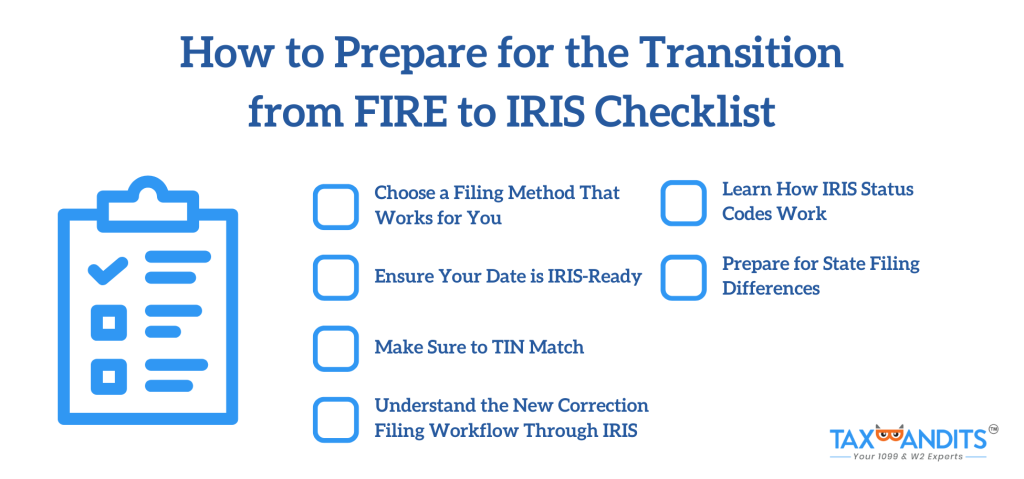
How to Prepare for the Transition from FIRE to IRIS
Transitioning to IRIS isn’t just about switching platforms—it’s about adapting to an entirely new filing process built on real-time validation, structured XML formats, and tighter compliance checks.
Here’s how to prepare effectively, and what key areas you need to focus on:
1. Choose a Filing Method That Works for You
IRIS supports two modes of filing:
- Web Portal: Best for businesses filing a smaller volume of returns. Users can upload pre-formatted CSVs or manually input data.
- Application-to-Application (A2A) API: Ideal for high-volume filers and software providers. Requires API integration and IRS-issued credentials. If you’re planning to use the A2A method, make sure to:
- Apply for an IRIS-specific TCC (your FIRE TCC won’t work)
- Register for a Client ID and begin integrating early
- Allocate time for the Assurance Testing System (ATS) to validate your submission flow
If you’re using an IRS-authorized e-filing provider like TaxBandits, you don’t need to manage all of these changes on your own. TaxBandits handles it all for you. You focus on preparing accurate recipient and payer data—we’ll take care of the IRS integration, formatting, validations, and filing.
2. Ensure Your Data is IRIS-Ready
IRIS replaces the traditional IRS Publication 1220 flat file format with structured XML. This means every field—such as name, TIN, and address—must meet strict formatting and validation rules. For example, name fields must be separated into first, middle, and last; numeric fields must follow precise formatting; and missing or misaligned data may trigger rejections.
While TaxBandits generates IRS-compliant XML behind the scenes, it’s still important for businesses to provide clean, structured input data. Ensuring accuracy upfront minimizes filing errors and prevents IRS rejections.
3. Make Sure to TIN Match
In the FIRE system, returns with incorrect TIN/name combinations were often accepted initially, only to trigger CP2100 notices later. But with IRIS, the IRS performs real-time validation during submission.
Here’s what’s changed:
- Payer TIN mismatches now result in an immediate rejection, stopping your submission from being processed altogether.
- Recipient TIN mismatches may result in the return being marked as “Accepted with Errors.” While the form is on file, the mismatch can still trigger IRS notices or penalties in the future.
That’s why TIN validation has become a crucial part of the preparation process.
If you’re using TaxBandits, our built-in TIN Matching service checks your data in advance, allowing you to correct any mismatches before filing. This proactive step helps prevent penalties and delays.
4. Understand the New Correction Filing Workflow Through IRIS
One of the more technical differences between FIRE and IRIS lies in how corrections are handled.
Under the FIRE system, corrections are made by submitting a separate file in the same 1220 format, identifying the record to be corrected using the TIN, name, and account number fields. This often caused issues when records were missing or contained incorrect identifying data.
With IRIS, the correction process is tied to a unique Record ID that’s assigned to every submission. This Unique Record ID must be referenced when submitting a correction, and the entire corrected record must be resubmitted in full.
More importantly, if you filed the original return via FIRE, you must correct it via FIRE. If you filed via IRIS, you must correct via IRIS.
TaxBandits tracks these Record IDs for you and simplifies the correction process. Whether your return was filed through FIRE or IRIS, we ensure the correction goes through the appropriate channel and includes everything the IRS requires.
5. Learn How IRIS Status Codes Work
Unlike the FIRE system, which gave basic Accepted or Rejected responses, IRIS introduces more detailed status codes to help filers understand the outcome of their submissions.
One important new status is “Accepted with Errors.” As of now, this status applies only to 1099 forms filed through IRIS.
How to understand the new status
If a 1099 return is marked Accepted with Errors:
- The IRS has accepted the form for processing.
- However, it contains issues like TIN mismatches or formatting errors.
- These issues don’t block the filing, but could lead to IRS notices or penalty letters later.
- If you receive this status, you must file a correction to fix the errors.
For 1099 forms filed with us, TaxBandits retrieves this status from the IRS, notifies you instantly, and guides you through the correction process seamlessly. Furthermore, to avoid “Accepted with Errors” outcomes due to incorrect recipient TINs, you can use TaxBandits’ TIN Matching services before filing.
6. Prepare for State Filing Differences
Even after IRIS becomes mandatory for federal filings, many states will still rely on the 1220 format—at least for the near term. This means you may need to maintain dual filing formats during the transition period.
If you’re using TaxBandits, our platform already handles this complexity by automatically generating the required formats for both federal and state filings, so you don’t have to manage multiple systems or workflows.
How TaxBandits is Leading the Transition to IRIS
At TaxBandits, we’re proud to be one of the first providers to obtain an IRIS TCC, and we’ve already built the tools you need for a smooth and compliant transition. We support both the current FIRE system and the emerging IRIS platform, giving you the flexibility to file based on the tax year and form requirements—no matter where you are in the process.
We’ve been involved in the IRS’s IRIS pilot and beta testing for over two years, working directly with their teams to shape the development, implementation, and integration of the new system. That early involvement has allowed us to stay ahead of every schema change, error code update, and IRS filing rule—so that you don’t have to.
Whether you’re filing a few dozen forms or managing bulk submissions across multiple clients, TaxBandits lets you:
- File through both FIRE and IRIS, depending on the form and filing year
- Submit corrections through either system
- Track new IRIS status codes, including “Accepted with Errors” for 1099 forms
- Prepare and transmit fully compliant forms for IRIS
- Manage TIN Matching, federal filing, and state filing needs in one place
Final Thoughts: Make the Move to IRIS with Confidence
The IRS is giving businesses until the end of 2026 to make the transition from FIRE to IRIS—but waiting too long could lead to avoidable complications. Starting now allows you to familiarize yourself with new validation rules, update your internal data practices, and ensure that you’re working with a provider who’s ready for what’s next.
TaxBandits takes care of the heavy lifting—from system integrations to XML formatting—so you can focus on filing returns accurately, on time, and with complete confidence.
Leave a Comment