

Crypto Cost Basis: How Brokers Report It on Form 1099-DA
reading time: 24 minute(s)
Picture a pizza shop that logs every pie sold but never records the cost of dough, cheese, and delivery drivers. The sales total looks great. But the profit? It’s anyone’s guess.
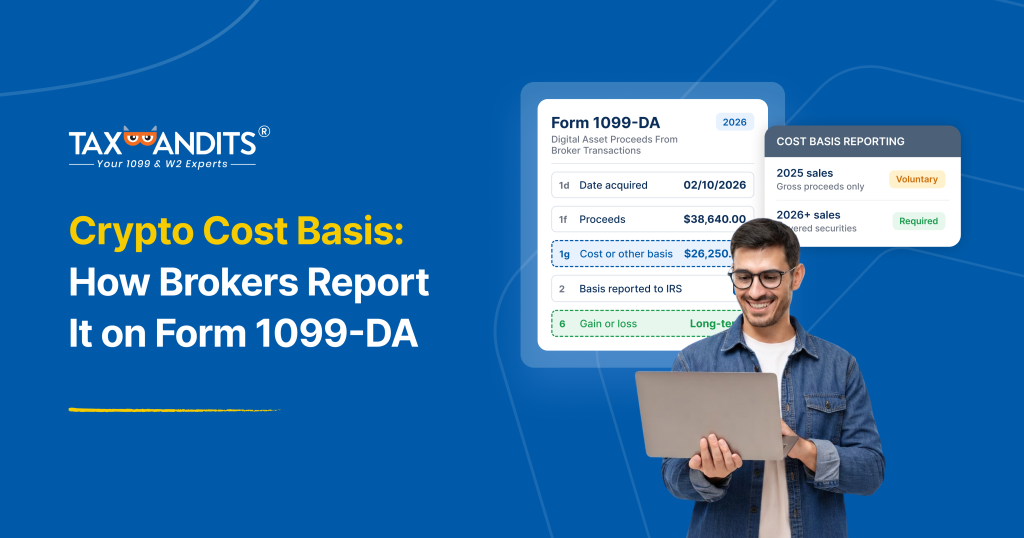
For the first year of Form 1099-DA, digital asset brokers were in a similar spot. Reporting gross proceeds was the requirement, and crypto cost basis was optional. That changes with 2026 sales, and the shift is bigger than adding one number to a box. You now have to decide, transaction by transaction, whether basis belongs on the form at all.
What cost basis means for a broker filing Form 1099-DA?
Cost basis is what a customer paid to acquire a digital asset, including fees, or the amount recognized as income if they received it as payment.
On Form 1099-DA, the IRS compares proceeds against basis to understand a customer’s gain or loss.
Your obligation depends on one question: Did the asset qualify as a covered security at the time of sale? Get that wrong, and the form is wrong in a way the customer, and eventually the IRS, will notice.
Who has to report basis?
Basis reporting applies to brokers. The IRS defines a broker as anyone who, in the ordinary course of business, stands ready to effect sales of digital assets for others. That includes a person who regularly offers to redeem digital assets they created or issued, and anyone who effects dispositions of customers’ digital assets as an agent, dealer, or digital asset middleman.
Generally, only a U.S. digital asset broker has to file Form 1099-DA. Software and hardware wallet providers, along with proof-of-work and proof-of-stake validators, aren’t treated as middlemen when they only provide those services.
When does basis reporting begin?
| Sales made in | Gross proceeds | Cost basis | Forms due to customers |
| 2025 | Required | Voluntary | Early 2026 |
| 2026 and later | Required | Required for covered securities | Early 2027 and each year after |
If your 2025 filings reported proceeds only, that was consistent with the phase-in period. The 2026 filing season is the first one where basis becomes a mandatory data point.
Which assets are covered securities?
A digital asset is covered when all of these are true:
- The customer acquired it on or after January 1, 2026.
- It was acquired in an account where you provide custodial services.
- It stayed in that account until you processed the sale.
Everything else is a noncovered security. That includes assets acquired before 2026, assets transferred in from another broker or a private wallet, and assets you never held in custody. For these, you aren’t required to report basis, although you can choose to.
Important: Moving an asset onto your platform doesn’t make it covered. Units transferred in are generally noncovered, even after 2026, so your system needs to flag how and when each unit arrived.
Box 9: Report basis for noncovered assets or not?
For noncovered securities, you have a choice, and your penalty exposure depends on how you make it. Box 9 is how you flag a noncovered security. Never check it for a covered security.
- Check Box 9 and leave the basis boxes blank: You don’t have to complete boxes 1d, 1g, 1h, 1i, or 6, and you don’t have to check Box 2.
- Check Box 9 and voluntarily complete the basis boxes: You aren’t subject to section 6721 or 6722 penalties if that information turns out to be wrong.
- Don’t check Box 9: You must complete boxes 1d, 1g, 1h (if applicable), 1i (if applicable), 2, and 6 correctly, and section 6721 and 6722 penalties apply to errors, even if the asset is noncovered.
In practice, checking Box 9 on every noncovered sale is a safer default unless you have reliable basis data and a reason to report it.
What goes on Form 1099-DA?
| Box | What to enter |
| 1d Date acquired | The acquisition date in MM/DD/YYYY format. Leave blank if the units were acquired on a variety of dates. |
| 1f Proceeds | Gross proceeds, reduced by transaction costs such as fees, commissions, and transfer taxes. |
| 1g Cost or other basis | The adjusted basis. Required for covered securities. |
| 2 Basis reported to IRS | Check if you aren’t checking Box 9, or if you check Box 9 but still report basis in 1g. |
| 6 Gain or loss | Short-term or long-term, plus “Ordinary” if any portion may be ordinary. Short-term and long-term can’t both appear on one form. |
| 8 Customer-provided acquisition information | Check if you relied on this information to identify which units were sold. |
| 12a / 12b Transfer-in | Number of units transferred in and the transfer date, when the units sold were transferred into your custody. |
Note: Box 1g has a specific rule for zero. Enter -0- only if the asset actually had a basis of zero. If you checked Box 9 and aren’t reporting basis, leave 1g blank. A blank and a zero mean different things to the IRS.
For exchanges of one digital asset for another, transaction costs the customer paid are generally allocated to the disposition of the transferred assets when determining basis. The instructions give a separate rule for cases where acquired assets are withheld to pay the costs of the original transaction. See Regulations sections 1.1001-7 and 1.1012-1(h)(2)(ii)(C) if your platform handles those.
Accrued market discount (Box 1h) and wash sale loss disallowed (Box 1i) apply to certain assets, mainly tokenized securities.
How many 1099-DA forms does one sale need?
Report each transaction on a separate Form 1099-DA, and split a single sale across forms when the assets fall into different categories. The IRS example shows how this works.
A custodial customer, Bill, buys units of digital asset ABC in April 2022, April 2026, and August 2026. In June 2027, he sells everything at once. The 2026 purchases are covered, and the 2022 purchase is noncovered, so you report the sale on three forms:
- Form 1: units bought in August 2026, covered, short-term.
- Form 2: units bought in April 2026, covered, long-term.
- Form 3: units bought in April 2022, noncovered, Box 9 checked.
If you voluntarily report basis on the 2022 units, you may combine them with the April 2026 units on one long-term form. The catch is that you then can’t check Box 9, and you’re subject to section 6721 and 6722 penalties for basis errors on the whole form, including the noncovered units.
Which units did the customer sell?
When a customer holds units bought on different dates or at different prices and sells part of the position, you report the sale based on the customer’s adequate and timely identification of the units. If they gave no identification at or before the time of the sale, you generally must report the earliest units purchased first.
Two details matter for your systems:
- If you don’t use customer-provided acquisition information, treat transferred-in units as acquired on the date and time of the transfer.
- Customer-provided acquisition information can be used for lot selection only. You can’t use it to report basis or acquisition dates.
The average basis method is available only for digital assets that are also tokenized securities where section 1012(c) or (d) permits it.
Assets with lighter basis requirements
Some assets don’t require basis reporting if you use the IRS’s optional reporting methods. A broker using an optional method isn’t required to report acquisition dates or basis amounts, even if the assets are covered securities.
- Qualifying stablecoins: Designated sales don’t need reporting if a customer’s aggregate gross proceeds, net of transaction costs, stay at or under $10,000 for the year.
- Specified NFTs: Sales don’t need reporting if aggregate gross proceeds stay at or under $600 for the year.
- Payment processors: Processors of digital asset payments don’t need to report PDAP sales of $600 or less per customer for the year.
Rewards and staking payments don’t go on Form 1099-DA at all. Notice 2024-57 also gives interim relief for wrapping, liquidity provider, staking, lending, short sale, and notional principal contract transactions.
Common filer mistakes to avoid
- Treating transfer-ins as covered. They’re noncovered, and Boxes 12a and 12b should show the units and date.
- Skipping Box 9 on noncovered sales without reporting complete, accurate basis. That leaves you exposed to penalties.
- Entering zero in Box 1g when basis is simply unknown. Leave it blank if you checked Box 9.
- Combining covered and noncovered units on one form without understanding the penalty trade-off.
- Reporting mixed holding periods on a single form. Short-term and long-term need separate forms.
- Using customer-provided acquisition data for basis. It’s allowed for lot selection only.
- Putting a wallet address in the account number field. The account number is the one you assign to the customer.
Filing Form 1099-DA with TaxBandits
Basis reporting turns Form 1099-DA from a proceeds summary into a data-quality exercise, with covered status, lot selection, and corrections all feeding into each form.
TaxBandits helps brokers prepare and e-file Form 1099-DA through a guided process, so you can review transaction details, catch errors before submission, and file corrections when needed.
Leave a Comment