

How to File Form 941 Electronically in 2026: A Complete Guide
reading time: 5 minute(s)
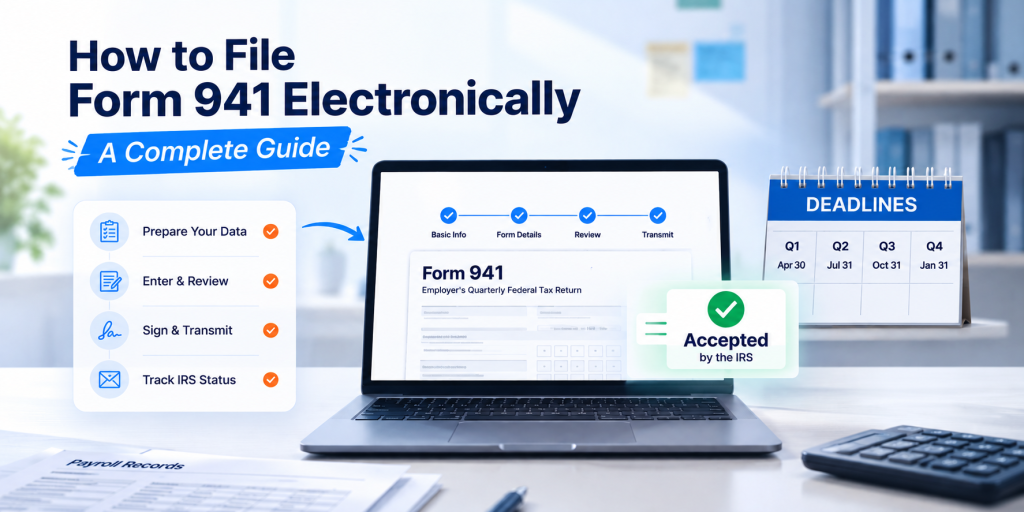
Every employer with employees on payroll has a quarterly obligation to the IRS: Form 941, the Employer’s Quarterly Federal Tax Return. It reports wages paid, tips received, federal income tax withheld, and the employer and employee shares of Social Security and Medicare tax for the quarter.
Filing this return accurately and on time is a core part of payroll tax compliance. Late or incorrect filings can trigger penalties, interest, and IRS notices that take time and resources to resolve. E-filing has become the standard method for meeting this requirement, offering faster processing, built-in accuracy checks, and clear visibility into your filing status at every step.
Whether you’re filing for your own business or managing payroll taxes for multiple clients, this guide will walk you through the 941 e-filing process, show you what to prepare before you begin, and help you avoid common filing mistakes along the way.
Let’s get started.
Before You Start: What You’ll Need
Having your information organized upfront saves time and prevents last-minute scrambling. Gather the following:
- Employer details: EIN, legal business name, trade name (if any), and business address
- Payroll totals: Wages, tips, and other compensation paid during the quarter
- Tax withholding: Federal income tax withheld, plus Social Security and Medicare taxable wages and tax amounts
- Deposit records: Documentation of federal tax deposits made throughout the quarter
- Schedule B: Required if you’re a semiweekly depositor, to report daily tax liability
- Supporting forms: Schedule R, Form 8974, or others that apply to your situation
- Signature method: A 94x Online Signature PIN, Form 8879-EMP, or Form 8453-EMP
- Payroll tax credits: Supporting calculations if you’re claiming any credits for the quarter

Quick tip: Most depositors fall into one of two categories, monthly or semiweekly, based on their total tax liability during the lookback period. If you’re not sure which one applies to you, check your prior-year Form 941 filings or your IRS deposit schedule notice.
How to File Form 941 Electronically
Once your information is gathered, you’re ready to file. E-filing means submitting your return through an IRS-authorized e-file provider rather than mailing a paper form. While the exact process varies by provider, the overall steps are generally the same.
Step 1: Select Form 941, Quarter, and Tax Year
Choose Form 941 along with the correct quarter and tax year you’re filing for. Confirm this matches the period your payroll records cover, since selecting the wrong quarter is one of the most common filing errors.
Step 2: Enter Your Payroll Data
Add your wages, tips, withholding, and deposit information for the quarter. Many e-file providers let you import this data from a spreadsheet or payroll system instead of entering it manually, reducing the chance of typos or transposed numbers.
Step 3: Complete Additional Forms
Depending on your filing situation, you may need to attach one or more supporting forms:
- Schedule B: Required if you’re a semiweekly depositor, to report your daily tax liability
- Schedule R: Required if you’re an aggregate filer reporting for multiple clients under one return
- Form 8974: Required if you’re claiming the qualified small business payroll tax credit for increasing research activities
Step 4: Review Your Return
Check your entries against your payroll records before submitting. Look specifically for mismatched totals, missing fields, and incorrect employer information. Most e-file platforms run a validation check at this stage and flag anything that looks off.
Step 5: Sign the Return
Authorize your return using one of the IRS-accepted signature methods: a 94x Online Signature PIN, Form 8879-EMP, or Form 8453-EMP. If you’re a tax professional filing for a client, you’ll typically need their authorization on file before you can transmit on their behalf.
Step 6: Transmit to the IRS
Submit your completed return. Once transmitted, you can track its status and expect an acknowledgment from the IRS, usually within 24 hours, confirming whether it’s been accepted or rejected.

If You Owe a Balance with Your 941 return
The IRS offers a few ways to pay:
- Electronic Funds Withdrawal (EFW): Authorize a direct debit from your bank account when you file, either immediately or scheduled up to the filing deadline
- Electronic Federal Tax Payment System (EFTPS): The IRS’s free payment portal, which most employers are already required to use for regular payroll tax deposits. Learn more about EFTPS
- Credit or debit card: Pay through an IRS-approved payment processor, with processing fees that vary by provider
- Check or money order: Mail your payment with Form 941-V, the payment voucher, if you’re not paying electronically
- IRS Online Account: Business taxpayers can also schedule or make payments directly through their IRS Online Account
Form 941 Filing Deadlines
Form 941 is due by the last day of the month following the end of the quarter.
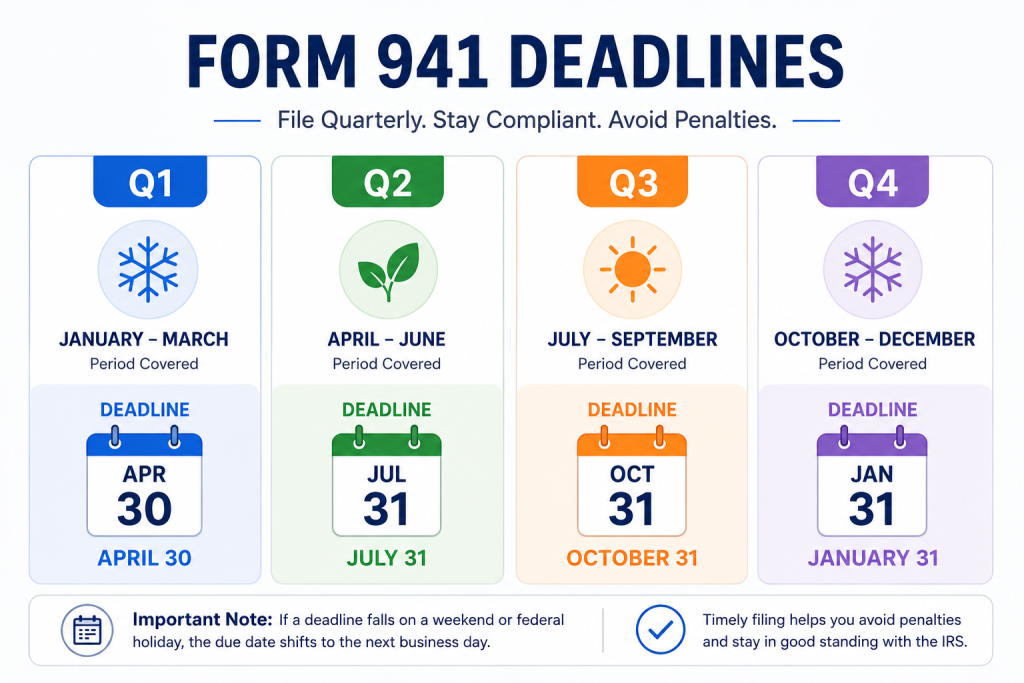
Note: If the 941 deadline falls on a weekend or federal holiday, the due date shifts to the next business day. If you made all required deposits in full and on time for the quarter, you also get an automatic 10-day extension on your filing deadline.
Filing circumstances that change your approach
Form 941 isn’t one-size-fits-all. The core form stays the same, but what you need to prepare and how much time it takes shift depending on your situation.
A few common scenarios:
- Filing for the first time. If this is your first quarterly return, expect a bit of a learning curve around depositor schedules and which supporting forms apply to you. Once you’ve filed one quarter, the rest tend to follow the same pattern.
- No wages paid this quarter. Seasonal businesses, or employers between hires, still need to file a zero return if they’re registered as active employers. Skipping the filing because there’s nothing to report is a common and avoidable mistake.
- Managing payroll without a dedicated team. Many small business owners handle payroll themselves. Keeping wage and deposit records organized throughout the quarter, not just at filing time, makes this far less time-consuming.
- Growing headcount or adding locations. As payroll gets more complex, so does your filing: more wages to reconcile, potentially new depositor schedule requirements, and more room for small errors to creep in.
- Switching from another payroll or filing service. Moving providers mid-year is common, but make sure your prior-quarter data and deposit history carry over accurately so nothing gets missed in the transition.
- Filing for multiple clients. Accountants and payroll professionals juggling several employers at once benefit from a process that keeps each client’s data, deadlines, and signatures organized separately.
- Prioritizing audit-ready compliance. Some organizations file with an eye toward future audits; keeping thorough records and documentation isn’t just about meeting the deadline, but about being able to substantiate the return later if needed.
Final Thoughts
E-filing Form 941 doesn’t have to be complicated. With the right preparation and the right e-file solution, you can simplify quarterly payroll tax filing, reduce errors, and stay compliant with IRS requirements.
Frequently Asked Questions
1. How long does IRS acceptance take after e-filing Form 941?
Most returns get an acknowledgment within 24 hours. If there’s an issue, the IRS sends a rejection notice explaining what to correct before you resubmit.
2. Can I e-file Form 941 myself?
Yes. Any IRS-authorized e-file provider lets you prepare, submit, and track your return online without mailing anything or working through a tax professional.
3. Can I file Form 941 if I had no wages this quarter?
Yes. If you’re still an active employer required to file, you’ll submit a zero return even without wages or withholding for that period.
4. What if I made a mistake after filing?
Don’t file a second original return. Use Form 941-X to correct errors in wages, tax withholding, credits, or other reported amounts.
5. Do I need to file Schedule B with Form 941?
Only if you’re a semiweekly depositor attach Schedule B (Form 941). Monthly depositors typically don’t need to attach it.
Leave a Comment