

reading time: 13 minute(s)
Expanding into the U.S. market can create new opportunities for a foreign corporation — customers, contracts, real estate, investments, partnerships, and revenue. But once a foreign corporation has U.S. activity or U.S.-source income, one question becomes important:
“Does the corporation need to file a U.S. income tax return?”
For many foreign corporations, the answer depends on the type of U.S. activity, whether income is connected with a U.S. trade or business, whether tax was fully withheld at source, and whether an income tax treaty applies.
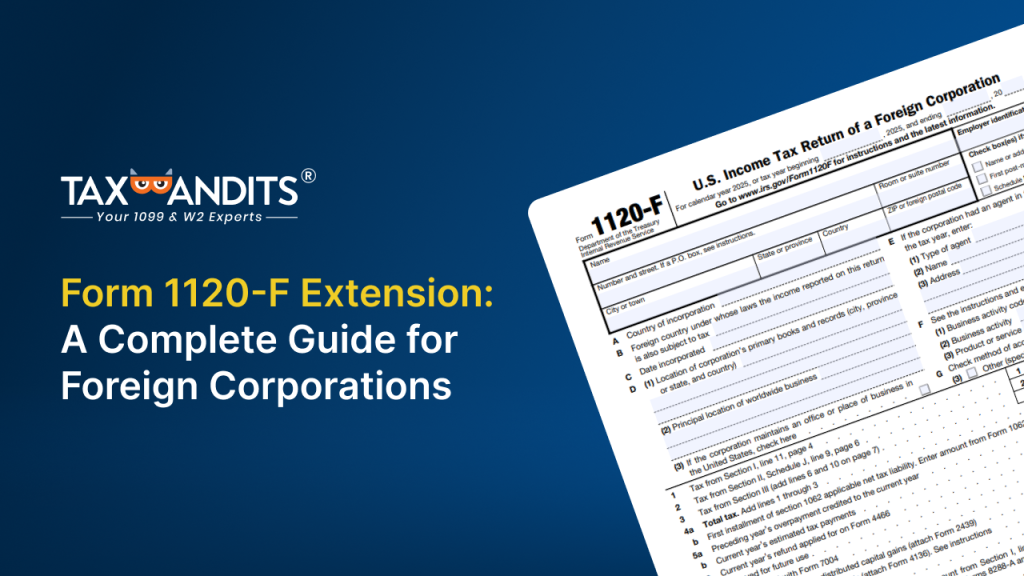
When a filing is required, the return is generally Form 1120-F, U.S. Income Tax Return of a Foreign Corporation.
What is Form 1120-F?
Form 1120-F is the U.S. income tax return used by foreign corporations to report certain U.S. income and calculate any federal tax liability.
Foreign corporations may also use Form 1120-F to:
- Report income, gains, losses, deductions, and credits
- Report income effectively connected with a U.S. trade or business
- Claim a refund of overwithheld U.S. tax
- Claim deductions and credits connected to effectively connected income
- Disclose certain treaty-based return positions
- Calculate branch profits tax or tax on excess interest, if applicable
In simple terms, Form 1120-F is the main U.S. corporate tax return for foreign corporations with reportable U.S. tax activity.
Who must file Form 1120-F?
A foreign corporation generally must file Form 1120-F if it was engaged in a trade or business in the United States during the tax year.
This filing requirement may apply even if:
- The corporation had no U.S.-source income from that trade or business
- The income is exempt from U.S. tax under an income tax treaty
- The corporation believes it does not owe U.S. tax
A foreign corporation may also need to file Form 1120-F if it has income, gains, or losses treated as effectively connected income, often called ECI.
Filing may also be required if the corporation was not engaged in a U.S. trade or business but received U.S.-source income and the full U.S. tax liability was not satisfied through withholding at source.
Form 1120-F deadline: When is it due?
The Form 1120-F deadline depends on whether the foreign corporation has a U.S. office or place of business.
- Foreign corporation with a U.S. office or place of business
If a foreign corporation maintains an office or place of business in the United States, Form 1120-F is generally due by the 15th day of the 4th month after the end of the tax year.
For a calendar-year corporation, this is generally April 15.
| There is a special rule for corporations with a fiscal tax year ending June 30. The return is generally due by the 15th day of the 3rd month after the end of the tax year. |
- Foreign corporation with no U.S. office or place of business
If a foreign corporation does not maintain an office or place of business in the United States, Form 1120-F is generally due by the 15th day of the 6th month after the end of the tax year.
For a calendar-year corporation, this is generally June 15.
If the due date falls on a Saturday, Sunday, or legal holiday, the deadline generally moves to the next business day.
How to file Form 1120-F extension
Foreign corporations can generally request an extension of time to file Form 1120-F using Form 7004, Application for Automatic Extension of Time To File Certain Business Income Tax, Information, and Other Returns.
A foreign corporation that does not have an office or place of business in the United States should generally file Form 7004 by the regular Form 1120-F due date.
For this category, the regular due date is generally the 15th day of the 6th month after the end of the tax year.
For a calendar-year foreign corporation with no U.S. office, this usually means:
- Original Form 1120-F deadline: June 15
- Form 7004 deadline: June 15
- Extended filing deadline: generally December 15
These filers should check line 2 on Form 7004 to indicate that the organization is a foreign corporation with no office or place of business in the United States.
Does Form 7004 extend the time to pay?
No. Form 7004 does not extend the time to pay tax.
A foreign corporation should estimate its tax liability and pay any required balance by the applicable payment deadline. Interest may apply to tax paid after the regular due date, even if the corporation has a valid extension to file.
The IRS instructions also state that if a corporation receives an extension of time to file, the late payment penalty generally will not apply if the tax shown on Form 7004, or the tax paid by the regular due date, is at least 90% of the total tax shown on the return and the remaining balance is paid by the extended due date.
File your 1120-F extension with TaxBandits
If your foreign corporation needs additional time to file Form 1120-F, TaxBandits can help you file Form 7004 online and request an automatic extension from the IRS. You can complete your extension request, report your tentative tax details, and transmit Form 7004 securely before the deadline.
Leave a Comment