

How are Gambling Winnings Taxed? What Gaming Operators Report and Withhold
reading time: 23 minute(s)
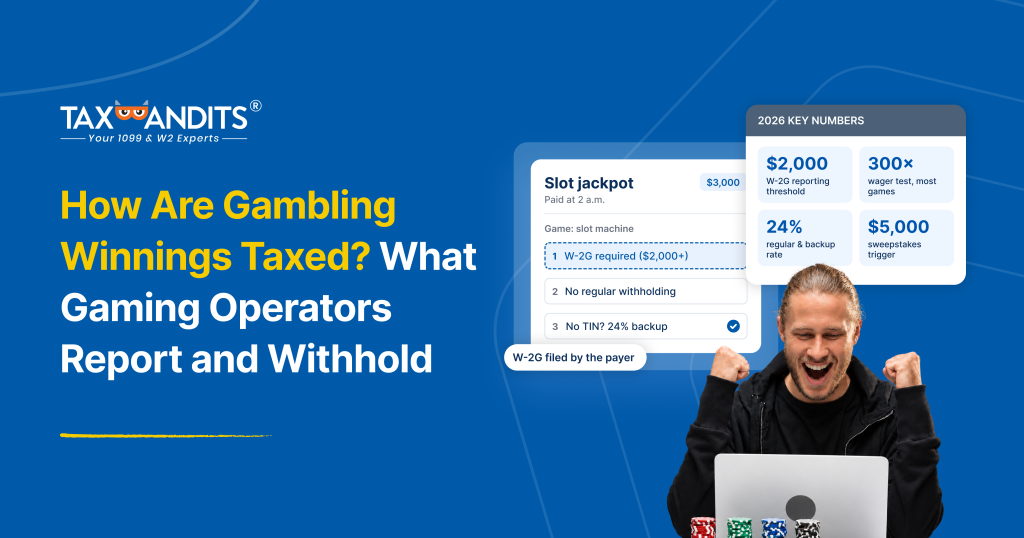
A guest hits a $3,000 slot jackpot at 2 a.m. Before anyone celebrates, the attendant must collect two forms of ID, one with a photo, along with a taxpayer identification number. But… what if the guest doesn’t have a TIN? Then the payout is about to get smaller.
How gambling winnings are taxed is mostly the winner’s problem when they file taxes on April 15.
But the paperwork and withholding that alert the IRS to those winnings happen at your counter, on your forms, and on your schedule.
Questions? Let’s dive into what gaming operators report and withhold for 2026 payments, based on the IRS Instructions for Forms W-2G and 5754.
How are gambling winnings taxed?
Gambling winnings are generally taxable income for the winner, whether or not the payer issues a form. The IRS sees those winnings through Form W-2G, which payers file to report gambling winnings and any federal income tax withheld. Winners also receive a statement, which they use to report the income on their own return.
Your role has two parts: reporting qualifying winnings, and withholding tax in specific situations. Those are separate rules, and a payout can trigger one without the other. A large slot jackpot, for example, can require a W-2G with no withholding at all.
Those are separate rules, and a payout can trigger one without the other. For example, a large slot jackpot can require a W-2G with no withholding at all.
Note: Winners can deduct losses only against winnings ( for 2026, the deductible portion of those losses is 90%). This only affects the winner’s return, so confirm the details with the IRS before telling anyone how it applies to them.
When do you have to file Form W-2G?
Report gambling winnings on Form W-2G when they’re subject to federal income tax withholding or when they meet the reporting threshold.
For payments made in 2026, the minimum threshold is $2,000, and it’s adjusted yearly for inflation. Visit TaxBandits to check the applicable threshold for each game type, as the amounts may differ.
The filing requirement varies by game:
- Bingo and slot machines: File when winnings meet or exceed the threshold. Total all winnings from all wagers made during a single bingo game to decide whether they’re reportable.
- Keno: File when winnings meet the threshold after you subtract the price of the winning wager.
- Poker tournaments: File when net winnings, reduced by the buy-in, meet the threshold. A player’s results in other tournaments you sponsor don’t count toward it.
- Horse racing, dog racing, jai alai, and other wagering: File when winnings meet the threshold and are at least 300 times the wager.
- Sweepstakes, wagering pools, and lotteries: Same 300-times test. Subtract the wager at the time of the first payment.
- Sports wagering: Same 300-times test.
Noncash prize? The fair market value of the item counts as the winnings.
Regular gambling withholding
Regular gambling withholding is 24%, and it applies when the winnings minus the wager are more than $5,000 from:
- Sweepstakes, wagering pools, or lotteries
- Parimutuel wagering on horse races, dog races, or jai alai, if the winnings are at least 300 times the wager
- Sports wagering and other wagering transactions, if the winnings are at least 300 times the wager
Regular withholding never applies to bingo, keno, or slot machine winnings and doesn’t apply to poker tournament winnings if you file Form W-2G and give the winner a copy.
Withholding is calculated on the full proceeds (winnings minus the wager). Report what you withheld in Box 4 and file Form 945 for all gambling withholding.
Noncash prizes such as a car in a sweepstakes follow a separate calculation. If the fair market value minus the wager exceeds $5,000, the winner can pay the withholding to you, which is 24% of that net value, or you can pay it yourself, which raises the rate to 31.58%. If you pay, enter the prize plus the tax in Box 1 and the tax you paid in Box 4.
Note: Installment payments of $5,000 or less still face regular withholding if the total proceeds will exceed $5,000, including lifetime annuities.
Backup withholding
Backup withholding is also 24%, and it exists to catch winners who don’t provide a correct TIN. You should backup withhold when all three of these are true:
- The winner doesn’t furnish a correct TIN.
- Regular gambling withholding hasn’t been withheld.
- The winnings meet the reporting threshold and, where it applies, are at least 300 times the wager.
Note: A payment already subject to regular withholding isn’t subject to backup withholding as well.
This rule applies to bingo, keno, slots, and poker tournaments. It’s calculated on total winnings, reduced at your option by the wager, not just the amount above the threshold.
Quick comparison by game type
| Game type | Reporting trigger | Regular 24% withholding |
| Bingo, slots | Winnings meet the threshold | No |
| Keno | Winnings minus wager meet the threshold | No |
| Poker tournaments | Net winnings meet the threshold | No |
| Sweepstakes, pools, lotteries | Threshold met and at least 300x wager | Yes, if winnings minus wager exceed $5,000 |
| Horse racing, sports, other wagering | Threshold met and at least 300x wager | Yes, if over $5,000 and at least 300x wager |
Backup withholding at 24% can apply to any of these when the winner doesn’t provide a TIN.
Verifying winners and completing the form
For most reportable payouts, winners must present two forms of identification, and one must include a photo.
Acceptable options include:
- Driver’s license
- Passport
- Social Security card
- Military ID
- Voter registration card
- A completed Form W-9
Two exceptions are worth noting:
- State-conducted lotteries don’t require identification beyond the TIN.
- Gaming establishments owned or licensed by a tribal government may waive the photo requirement for payees who are members of that tribe and present a tribal ID card issued by it.
Note: Box 9, the winner’s TIN, is required on every form.
Identical wagers matter for 300-times and threshold tests. Wagers placed with the same payer are identical when winning depends on the same event or events, and for horse racing, dog racing, and jai alai, when they’re in the same parimutuel pool.
Add their winnings together for reporting and withholding and put the additional winnings from identical wagers in Box 7.
Gaming-day aggregation. For bingo, keno, and slots, you may use an optional method that combines multiple reportable payments to one payee within a 24-hour calendar day or “gaming day” onto a single form. Your gaming day ends at a time you choose, and all open reporting periods must close at 11:59 p.m. on December 31 and restart at 12:00 a.m. on January 1.
When the person at the counter isn’t the winner
If the person receiving the winnings isn’t the actual winner, or the winnings are shared, use Form 5754 to collect the information needed for W-2G by:
- Having the recipient fill it out
- They sign under penalties of perjury if regular withholding applies
- Keeping Form 5754 for your records
- Don’t send it to the IRS.
- Issuing the resulting forms right away or by January 31 after the year of payment
For shared winnings, use the total, minus the wager, to decide whether thresholds are met. Don’t split the prize among winners first. If two people split a $5,002 sweepstakes win on a $1 ticket, the proceeds are $5,001, so you withhold 24% of $5,001 and then prepare a separate W-2G for each person.
Nonresident alien winners
Winnings paid to a nonresident alien or a foreign entity aren’t reportable on Form W-2G. They’re generally subject to 30% withholding and reported on Forms 1042 and 1042-S instead.
However, winnings of a nonresident alien from blackjack, baccarat, craps, roulette, or the big-6 wheel aren’t subject to withholding or reporting.
Mistakes that cause problems
- Using the old $1,200 and $1,500 thresholds for 2026 payments instead of the current figure.
- Withholding only on the amount over $5,000. The percentage applies to the full proceeds.
- Withholding regular tax on slots or bingo. Only backup withholding can apply to those games.
- Allocating group winnings before testing thresholds.
- Skipping the second ID or the TIN, then not applying backup withholding.
- Forgetting Form 945 to report the withholding you collected.
Filing Form W-2G with TaxBandits
With different thresholds by game, 300-times tests, two withholding rules, and ID requirements, W-2G errors often start at payout. TaxBandits helps gaming operators prepare and e-file Form W-2G through a guided process, so you can review winner details and withholding entries before submission and file corrections if something changes.
Leave a Comment