

reading time: 12 minute(s)
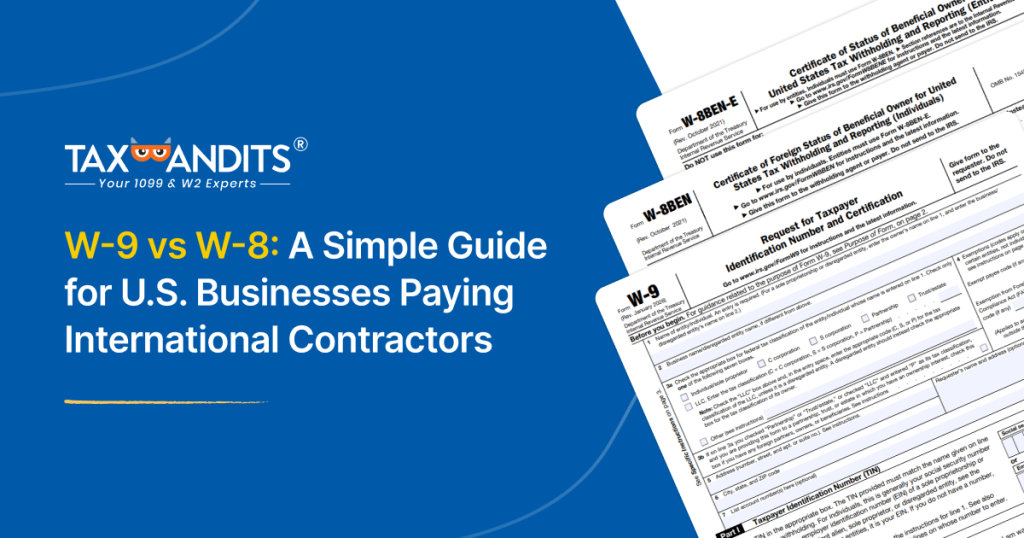
If you’re running a U.S. business and working with freelancers or contractors, taxes already feel like enough of a puzzle. Now add international contractors into the mix—and suddenly forms like W-9 and W-8 start showing up everywhere.
At first glance, they may look similar. Both are just tax forms, right? But here’s the catch: using the wrong one can lead to delays, backup withholding issues, or even compliance headaches you didn’t sign up for.
The good news? Once you understand the simple difference between W-9 and W-8, everything starts making sense. Let’s break it down in a clean, no-stress way so you know exactly which form to use and when.
The simple rule: U.S. vs international contractors
Before diving into details, here’s the easiest way to remember everything:
- If the contractor is based in the U.S. → Use Form W-9
- If the contractor is outside the U.S. → Use Form W-8 (commonly W-8BEN for individuals)
That’s the core difference. Everything else is just supporting detail.
Once you know where your contractor is located for tax purposes, the correct form becomes obvious.
W-9 form: The basics you should know
Form W-9 is used when you are paying individuals or businesses that are considered U.S. persons for tax purposes.
This includes U.S. citizens, resident aliens, and U.S.-based freelancers or vendors.
The main purpose of the W-9 is to collect the contractor’s Taxpayer Identification Number (TIN), which could be a Social Security Number (SSN) or Employer Identification Number (EIN).
This information is used later for reporting payments to the IRS, typically through Form 1099-NEC.
Key points about W-9:
- Used only for U.S.-based contractors
- Helps collect TIN for reporting
- Not submitted to the IRS directly
- No tax is withheld at the time of payment
Understanding Form W-8BEN (International contractors)
Form W-8BEN is used when you are paying individuals who are not U.S. tax residents.
In simple terms, it confirms that the contractor is a foreign person and not subject to the same tax reporting rules as U.S. contractors.
This form also helps determine whether any tax treaty benefits apply, which may reduce or eliminate withholding tax on payments.
Here’s a quick overview of the other types of Form W-8:
- Form W-8BEN-E – Used by foreign businesses or entities to certify their tax status outside the U.S.
- Form W-8ECI – Used when income is effectively connected with a U.S. trade or business.
- Form W-8EXP – Used by foreign governments, international organizations, or tax-exempt foreign entities.
- Form W-8IMY – Used by foreign intermediaries and flow-through entities to certify their status as intermediaries for withholding tax purposes.
W-9 vs W-8BEN: Quick comparison
Here’s a simple comparison to make it clearer:
| Aspect | Form W-9 | Form W-8BEN |
|---|---|---|
| Who it is for | U.S. individuals and businesses | Non-U.S. individuals |
| Tax withholding | No withholding at payment time | May apply withholding based on rules |
| Purpose | U.S. tax reporting (1099 forms) | International payment compliance |
| Status confirmed | U.S. tax status | Foreign tax status |
When should you collect these forms?
Timing plays a big role in getting tax compliance right. These forms are not something you wait to collect during year-end filing—they are part of your pre-filing preparation process.
Getting them early ensures smooth and accurate reporting when tax season begins.
You should collect them:
- Before the first payment
- During contractor onboarding
- When tax details change
- Well before the year-end tax filing starts
Think of it as setting up your foundation early—so when tax season arrives, everything is already organized and ready to go.
Final Takeaway
Managing contractor payments becomes much easier when your tax documentation is handled from the beginning. When forms are collected early and stored properly, it helps prevent last-minute confusion during the reporting season and keeps your compliance process running smoothly.
Instead of chasing details at year-end, it’s always better to streamline everything right from onboarding. With TaxBandits, you can securely request and collect contractor tax forms in one place—and the best part is, the request process is completely free. It helps you reduce manual follow-ups, stay organized, and be fully ready for filing without stress.
With the right system in place, compliance becomes less of a burden and more of a simple, managed workflow.
Leave a Comment