

reading time: 14 minute(s)
If you traded, sold, or exchanged cryptocurrency in 2025, your tax situation just got a lot more structured.
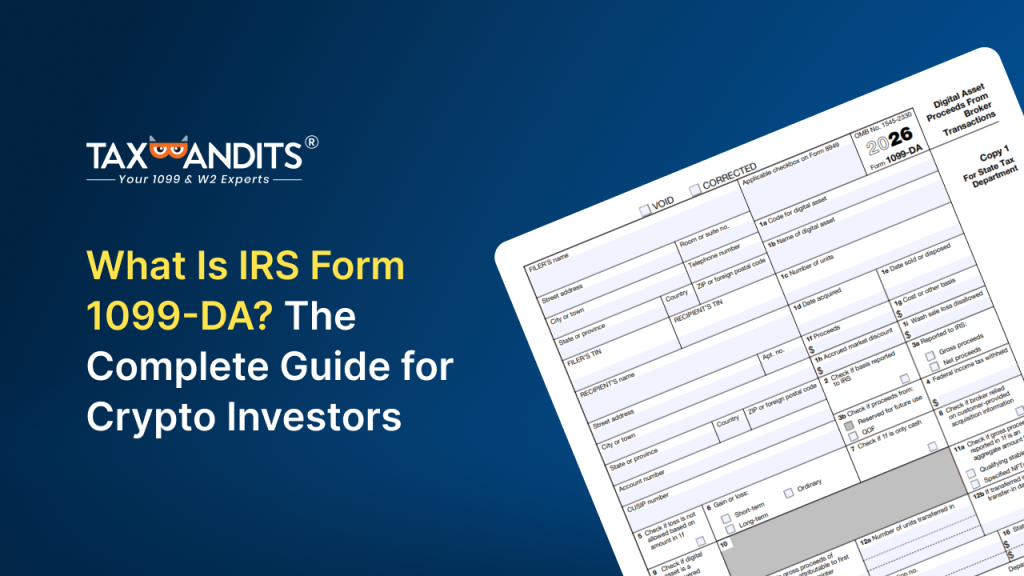
For the first time, centralized crypto exchanges are required to report your digital asset transactions directly to the IRS—the same way a stockbroker reports your trades. The form they use to do this is called Form 1099-DA, where “DA” stands for Digital Assets.
This isn’t a new tax. It’s a new reporting requirement—one that makes it significantly easier for the IRS to verify whether you’re accurately reporting your crypto activity. Whether you’re a casual holder or an active trader, this form is now part of your tax reality. Here’s everything you need to know.
What is Form 1099-DA?
Form 1099-DA is an IRS information return created specifically for digital assets. It’s filed by brokers—not by you—to report proceeds from your digital asset transactions to both you and the IRS.
Think of it as the crypto equivalent of Form 1099-B, which stock brokers have been issuing for years. The IRS created 1099-DA to bring the same level of reporting transparency to crypto that already exists in traditional financial markets.
According to the IRS, a digital asset is any value recorded on a cryptographically secured distributed ledger—such as a blockchain—that is not government-issued currency. In practice, this covers:
- Cryptocurrencies — Bitcoin, Ethereum, and similar tokens
- Stablecoins — such as USDC or USDT
- NFTs — non-fungible tokens
Receiving this form doesn’t create any new tax obligation. Your duty to report crypto gains and losses has always existed. What’s new is that the IRS can now match what you report against what your broker reports—making it much harder to overlook transactions.
Who sends it and who gets it?
Who sends it:
The IRS requires any U.S.-based digital asset broker to issue Form 1099-DA. According to the IRS instructions, a broker is anyone who, in the ordinary course of business, stands ready to effect digital asset sales on behalf of others. This includes:
- Centralized exchanges like Coinbase, Kraken, and Gemini
- Digital asset payment processors
- Crypto kiosk operators
Who receives it:
You’ll receive a Form 1099-DA if you used a U.S. broker and performed any of the following in 2025:
- Sold or exchanged a digital asset
- Used crypto to pay for goods or services
- Traded one digital asset for another
One important caveat: The 1099-DA requirement currently applies only to U.S. brokers. If you traded on a foreign exchange, you likely won’t receive this form—but you’re still legally required to report those transactions on your tax return.
What does Form 1099-DA actually report?
This is where most crypto investors need to pay close attention—because what the form reports in 2025 is deliberately limited.
What your broker will report:
For every transaction, your broker will report:
- The name and type of digital asset sold
- The number of units sold
- The date of the sale
- The gross proceeds received (after deducting transaction fees)
What’s missing and why it matters:
According to the IRS instructions, brokers are not required to report cost basis (what you originally paid) for 2025 transactions. This means the acquisition date, original purchase price, and your actual gain or loss may all be left blank.
This is critical because gross proceeds alone don’t determine your tax bill—your gain or loss does.
What do you need to do as an investor?
Receiving a Form 1099-DA doesn’t mean your work is done—it’s just the starting point.
- Review your form — Since cost basis isn’t mandatory yet, key information may be blank. Cross-check it against your own transaction history.
- Calculate your gain or loss — Subtract what you originally paid (including fees) from your sale proceeds. This is what actually gets taxed, not the gross proceeds.
- Report on your tax return — Use Form 1099-DA alongside your own records to report on Form 8949 and Schedule D.
- No form doesn’t mean no obligation — If you traded on a foreign exchange or a platform not required to issue 1099-DA, you’re still legally required to report those transactions.
Common pitfalls to avoid
- Don’t rely solely on the form — Cost basis may be missing, so gross proceeds alone can lead to incorrect reporting.
- Transfers between platforms — If you moved assets before selling, your broker may have no record of your original purchase price.
- DeFi and peer-to-peer activity — These transactions won’t appear on any 1099-DA, but you’re still required to report them.
- IRS matching — Any mismatch between your return and what your broker reported can trigger an automated IRS notice.
What’s next?
The IRS’s ability to verify crypto activity will only get stronger from here. To stay prepared, you can rely on TaxBandits to simplify your 1099-DA filing with an efficient e-filing process and built-in accuracy checks. It also helps you manage recipient details and stay compliant as reporting requirements evolve.
The best thing you can do right now is keep detailed records of every transaction—what you bought, when, at what price, and where.
Form 1099-DA is just the beginning. Understanding it now puts you well ahead of tax season.
Leave a Comment