

reading time: 28 minute(s)
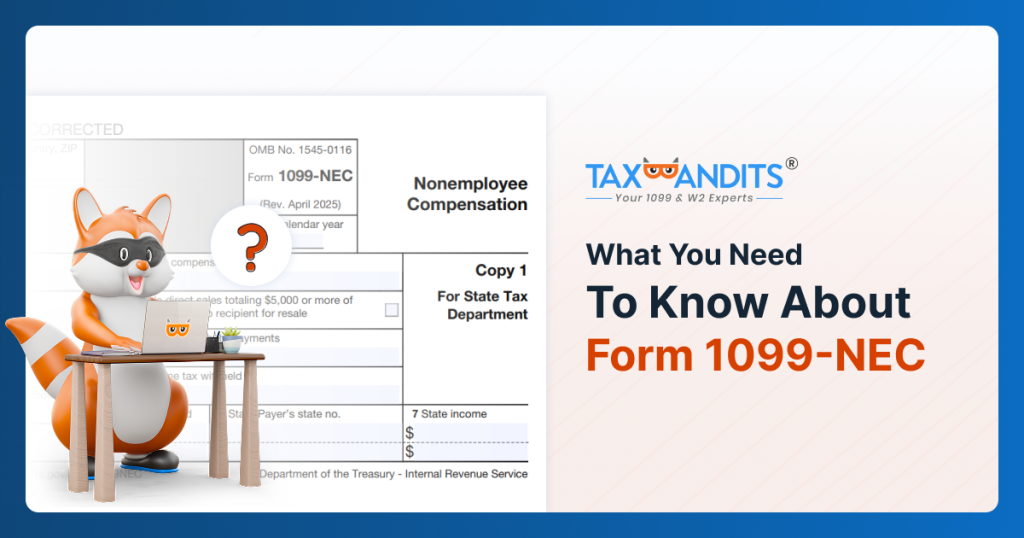
If you’ve ever paid an independent contractor, a freelancer, or any nonemployee for services, you’ve probably heard about Form 1099-NEC. It might seem like just another piece of paperwork, but this form is actually a big deal for keeping your business compliant with the IRS.
At first glance, it looks straightforward — report payments over $600, send it to the IRS, done, right? But there’s more to it. Knowing what counts as reportable, which payments to include, and the deadlines to meet can save you from costly mistakes or last-minute stress.
In this guide, we’ll walk you through everything you need to know about Form 1099-NEC — from what counts as reportable to common mistakes and simple ways to get it right. No fluff, no confusion, just the info you need to stay ahead.
What is Form 1099-NEC
Form 1099-NEC, Nonemployee Compensation, is the IRS tax form used to report payments made to individuals or businesses who provide services to your company but are not your employees. This includes independent contractors, freelancers, consultants, and certain professionals such as attorneys or accountants.
The purpose of this form is to ensure that all income earned by nonemployees is properly reported to the IRS for tax purposes.
For example, if you hire a freelance designer to create your company logo and pay them $1,200 in a year, you must report this payment on Form 1099-NEC. Similarly, if you pay an attorney $800 for legal consultation, that payment is also reported on this form.
Who needs to file Form 1099-NEC?
Any business that pays an independent contractor, freelancer, attorney, or other nonemployee $600 or more during a tax year must file Form 1099-NEC.
Businesses include:
- Sole proprietorships
- Partnerships
- Corporations (in limited cases, such as payments for legal services)
- Nonprofits that pay contractors for services
Even if a contractor is a corporation, payments for legal services must still be reported.
Failing to file when required can result in penalties, so it’s crucial to understand who qualifies as a recipient and what counts toward the $600 threshold.
Information you’ll need before filing
Before completing Form 1099-NEC, it’s crucial to have accurate information for each contractor or nonemployee. Key details you should gather include:
- The recipient’s legal name
- Taxpayer Identification Number (TIN), usually a Social Security Number (SSN) or Employer Identification Number (EIN)
- Total payments made during the year
- Recipient’s business address
- Any backup withholding amounts, if applicable
The most reliable way to collect the recipient information is through Form W-9, which is specifically designed for this purpose. Ensuring you have the correct TINs and payment records upfront will help prevent errors, IRS notices, or delays in filing.
Understanding the key boxes on Form 1099-NEC
Form 1099-NEC may look simple at first, but understanding what goes in each box is essential to avoid mistakes. Here’s a breakdown of the most important boxes:
Box 1: Nonemployee Compensation
- Any payments of $600 or more made to nonemployees for services performed in the course of your business should be reported here.
Box 2: Direct Sales of $5,000 or More
- This box is checked when you make consumer product sales totaling $5,000 or more to a person on a buy-sell, deposit-commission, or other commission basis for resale outside a permanent retail establishment.
- You do not report the dollar amount here, only an “X” to indicate that the threshold has been met. This ensures that large-scale resale activities are properly flagged for IRS oversight.
Box 3: Excess Golden Parachute Payments
- This box is for reporting any portion of a golden parachute payment that exceeds the base amount of a disqualified individual’s average annual compensation. These payments often occur during corporate ownership changes and must be carefully calculated according to IRS rules to avoid errors.
Box 4: Federal Income Tax Withheld
- If you had to apply backup withholding due to missing or incorrect TINs, the amounts withheld go in this box. Backup withholding is generally required at the standard IRS withholding percentage when the payee fails to provide a valid taxpayer identification number. Reporting this correctly ensures the IRS knows the correct amount has already been withheld.
Boxes 5–7: State Information
- These boxes are optional and are used if you need to report state-specific payments or state tax withheld. Box 5 is for the amount of state income tax withheld, Box 6 is for the state abbreviation and payer’s state identification number, and Box 7 is for the state payment amount. While not always required, using these boxes correctly can simplify state tax reporting.
Special rules you shouldn’t miss
When reporting on Form 1099-NEC, there are a few special rules that can easily be overlooked but are important to keep in mind.
- Payments to Attorneys: Even if the attorney is incorporated, payments of $600 or more for legal services must be reported in box 1. This rule ensures that all legal fees are properly tracked for tax purposes. However, gross proceeds paid to attorneys (not for services) should be reported in Box 10 of Form 1099-MISC, not on Form 1099-NEC.
- Golden Parachute Payments: If your business makes a parachute payment to a former employee or contractor, report any amount that exceeds the individual’s base compensation. These payments are included in box 1 and can have specific tax implications
- Payments by a Federal Executive Agency for Services (Vendors): Payments made by a federal executive agency to a vendor (such as independent contractors or businesses) for services must also be reported in Box 1 on Form 1099-NEC, if the total payments exceed $600. These payments ensure compliance with government contracting requirements and help the IRS track vendor payments.
- Payments on Behalf of Another Party: If you make payments for services on behalf of another party (such as a bank making payments on behalf of a real estate developer), you may still be required to file Form 1099-NEC if you have significant control or oversight over the payment. For example, banks that make payments to contractors in construction projects may need to file.
- Directors’ Fees: Directors’ fees and other remuneration (including payments made after retirement) should be reported on Form 1099-NEC in Box 1, as long as the total amount paid is $600 or more.
- Lottery Commission Payments: If your state has control over online and instant lottery games and pays $600 or more in commissions to licensed sales agents, these payments must be reported on Form 1099-NEC, in Box 1.
Following these rules carefully prevents misreporting and keeps your business compliant with IRS expectations.
Exceptions: Payments that do not belong on Form 1099-NEC
While Form 1099-NEC is required for most nonemployee payments, there are certain payments that you do not need to report. Being aware of these exceptions can help you avoid unnecessary filings and prevent confusion. Common exceptions include:
- Payments to corporations – Generally, the following payments made to corporations are reported on Form 1099-MISC.
- Cash payments made for purchasing fish intended for resale, reported in box 11.
- Payments related to medical and healthcare services, reported in box 6.
- Substitute payments, such as those replacing dividends or tax-exempt interest, reported in box 8.
- Gross proceeds paid to attorneys, reported in box 10.
- Employee wages and benefits – Any wages, bonuses, travel allowances, or other compensation paid to employees should be reported on Form W-2, not Form 1099-NEC.
- Merchandise, supplies, and other non-service items – Payments for goods, shipping, storage, or similar items are not reportable.
- Rent payments through property managers – Rent payments to property managers or real estate agents are reported by them to the property owner, not by you.
- Certain government and tax-exempt payments – Payments made to tax-exempt organizations, U.S. or foreign governments, and certain state programs like HFA Hardest Hit Funds are not reportable.
- Scholarships, fellowships, and difficulty-of-care payments – Scholarships, fellowships, or certain Medicaid or foster care payments are generally excluded from Form 1099-NEC reporting.
- Canceled debts – Canceled debts are reported on Form 1099-C instead.
- Employee business expense reimbursements – Reimbursements under accountable plans are usually not reported, while nonaccountable plan reimbursements are reported on Form W-2.
Knowing these exceptions ensures you focus only on payments that truly require reporting, keeping your filings accurate and compliant.
Key deadlines for filing Form 1099-NEC
The deadline for filing and furnishing Form 1099-NEC is January 31 of the year following the payment year. By this date, you must submit the form to the IRS and also provide a copy to the contractor or nonemployee who received the payment.
If January 31 falls on a weekend or a legal holiday, the deadline moves to the next business day.
Since this filing happens right after year-end, it’s best to plan ahead. Having contractor details reviewed early can help you meet the deadline without rushing or dealing with avoidable issues.
Penalties for late or incorrect filings
Missing the January 31 deadline or submitting incorrect information can cost you. The IRS penalties depend on how late the form is filed and the size of your business:
- Filed within 30 days late: $60 per form
- Filed more than 30 days late but before August 1: $130 per form
- Filed after August 1 or not filed at all: $340 per form
- Intentional disregard of filing requirements: $680 per form
Even small mistakes, like a wrong TIN or payment amount, can trigger these penalties, making accuracy critical
A simple and reliable way to file Form 1099-NEC with TaxBandits
Filing Form 1099-NEC doesn’t need to slow you down or add unnecessary pressure. TaxBandits, the IRS-authorized e-file provider, helps you file with confidence using built-in audit checks that flag issues before submission. From small businesses to high-volume filers, the platform is designed to keep things accurate and on track.
With secure data handling, real-time filing updates, and a clear step-by-step process, TaxBandits helps you stay compliant without the usual back-and-forth. You file on time, reduce the risk of penalties, and move forward knowing your 1099-NEC filings are done right–backed by the Bandit Commitment.
Watch our quick video to see how easy it is — check it out
Leave a Comment