

reading time: 13 minute(s)
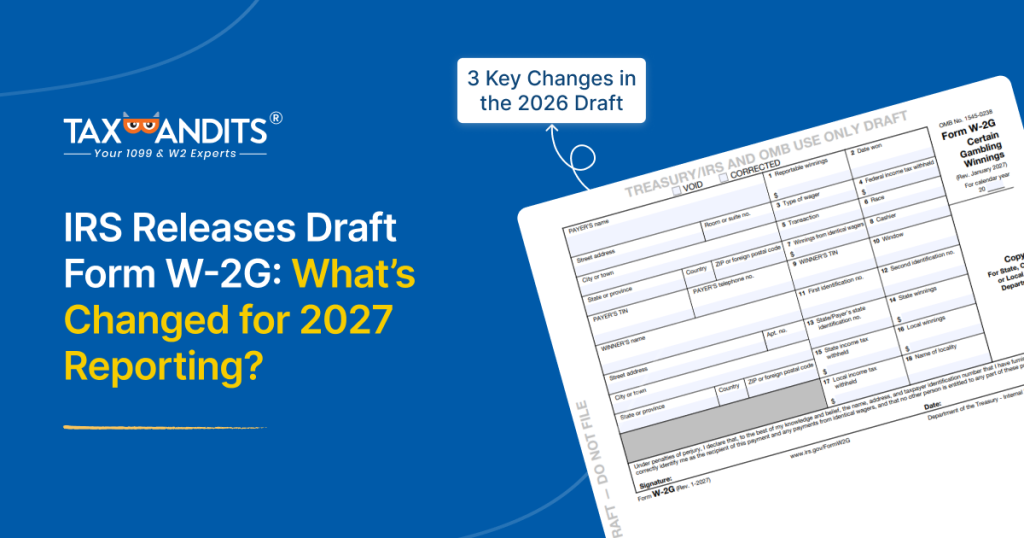
Form W-2G is the information return that casinos, sportsbooks, and other gaming operators file with the IRS to report gambling winnings and any federal income tax withheld on those winnings. Recipients use the form when reporting gambling income on their individual tax returns.
The IRS has released an early draft of the 2026 Form W-2G instructions, filed in 2027. Since the instructions are still in draft status, filers should not treat them as final guidance. Still, the draft highlights several areas that payers, recipients, and tax professionals should monitor before the filing season begins.
1. Sports wagering is now explicitly listed as a reportable category
For years, Form W-2G listed specific gambling categories—horse racing, dog racing, jai alai, bingo, keno, and poker tournaments, along with their applicable thresholds. Sports wagering was never named directly. Operators were left to apply the rules by inference, treating sports bets under a catch-all category labeled “other wagering transactions not discussed later.”
The 2026 draft changes that. Sports wagering now appears as its own named category, with reporting and withholding requirements stated directly in the instructions.
The thresholds themselves have not changed:
- A W-2G must be filed when winnings are at least 300 times the amount of the wager
- Federal income tax must be withheld at 24% when the proceeds, meaning winnings minus the wager, exceed $5,000, and the 300-times threshold is also met
What has changed is that sportsbooks and other sports wagering operators now have explicit IRS guidance to work from, rather than relying on a category that was never designed with their industry in mind. This makes it easier to support compliance decisions, train staff, and respond to audit inquiries with a direct instructional reference.
2. Identical wagers must be aggregated before testing thresholds
When a bettor places the same wager more than once, those wagers and their resulting winnings must be combined before testing whether the reporting or withholding threshold has been crossed. Each bet cannot be evaluated in isolation.
This clarification is especially relevant for sports wagering, where a single bettor might place the same point spread or parlay structure multiple times within a session. Winnings that appear small on a per-bet basis can quickly exceed reporting thresholds once totaled.
For payers, this means:
- Tracking repeated identical wagers within a session, not just individual transactions
- Combining those totals before applying the 300-times and $5,000 thresholds
- Confirming that internal systems aggregate correctly, rather than evaluating each wager independently
Without aggregation, individual bets can stay below the reporting line while the combined winnings clearly should have triggered a W-2G. The draft closes that gap directly.
3. Professional gamblers now have a separate reporting path
Under the 2025 instructions, all gambling winners were directed to report winnings as “Other income” on Schedule 1, regardless of whether gambling was a hobby or a profession. The 2026 draft adds a second path based on how the recipient approaches gambling for tax purposes:
- Recreational gamblers continue to report winnings as “Other income” on Schedule 1, with no change to this process
- Individuals in the trade or business of gambling are now directed to report winnings and losses on Schedule C
- Partnerships engaged in the trade or business of gambling are directed to Schedule E
This is a meaningful distinction. Schedule C allows professional gamblers to deduct ordinary and necessary business expenses and introduces self-employment tax considerations that do not apply under Schedule 1.
For partnerships, increasingly common in professional sports betting and poker, Schedule E ensures that income flows through to individual partners properly rather than being reported as personal “Other income.” The 2026 draft provides recipients with a clear, form-based reference to these separate reporting paths for the first time.
What should filers do now?
Because this is still a draft, payers, gaming operators, and tax professionals should treat these updates as planning items rather than final filing instructions.
Before 2027 reporting begins, review:
- W-2G filing requirements for sports wagering, including the 300-times and $5,000 thresholds
- System logic for identifying and aggregating identical wagers before threshold testing
- Schedule C and Schedule E reporting guidance for clients who gamble professionally or operate through a partnership
- Any further updates once the IRS releases the final 2026 Form W-2G instructions
File Form W-2G with TaxBandits
TaxBandits supports Form W-2G e-filing and monitors IRS form updates each tax year. Once the IRS finalizes the TY 2026 Form W-2G and instructions, TaxBandits will reflect confirmed changes to help gaming operators, payers, and tax professionals file accurately and stay compliant.
Leave a Comment