

reading time: 14 minute(s)
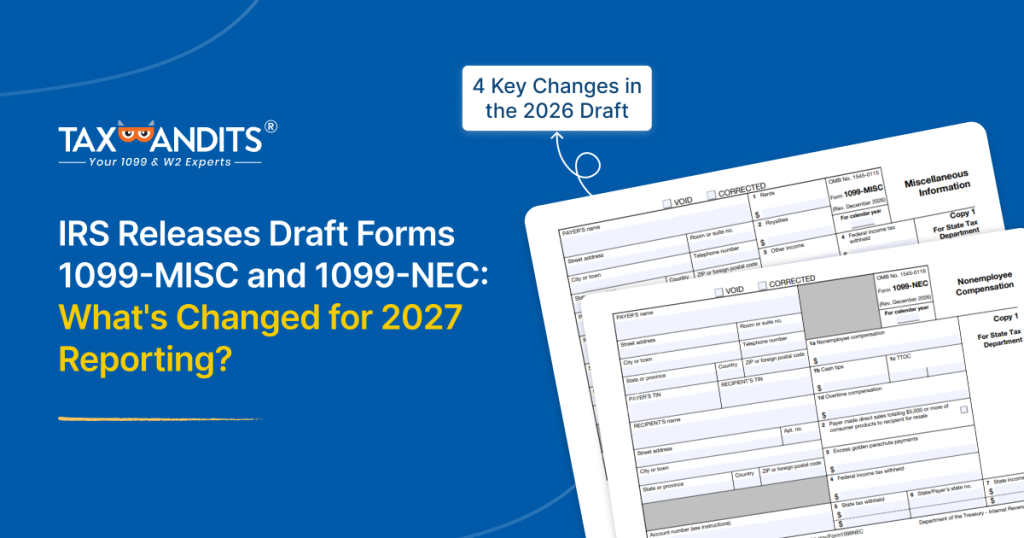
Forms 1099-MISC and 1099-NEC are the information returns businesses file with the IRS to report miscellaneous payments and nonemployee compensation. The IRS has released draft December 2026 versions of both forms, covering 2026 payment activity that will be reported in early 2027.
Since the instructions remain in draft status, filers should not treat them as final guidance. Still, the draft introduces several significant changes, including new reporting boxes, a substantially higher filing threshold, and the removal of a long-standing exception. Reporting teams should start planning well before filing season opens.
1. The General Reporting Threshold Jumps from $600 to $2,000
The most far-reaching change is the increase in the general reporting threshold. For tax years beginning after 2025, most payments only need to be reported once aggregate payments to a single payee reach $2,000 in a calendar year. This threshold also applies to backup withholding obligations, and it’s scheduled for inflation adjustments starting in 2027.
The new $2,000 floor affects a wide range of payment categories on both forms, including:
- Rents and other income
- Medical and health care payments
- Crop insurance proceeds and fish purchased for resale
- Section 409A deferrals and nonqualified deferred compensation
- Nonemployee compensation, now reported in Box 1a on Form 1099-NEC (shifted from the former Box 1)
Two thresholds remain untouched. Gross proceeds paid to attorneys (Box 10 on Form 1099-MISC) stay at $600. Royalties and substitute payments in lieu of dividends or interest keep their $10 minimum.
For businesses, the practical effect is fewer required filings. A contractor paid $1,500 for the year won’t trigger a 1099-NEC. But the income is still fully taxable whether or not a form is issued. Threshold logic, validation rules, and automated 1099 workflows should all be updated to reflect the $2,000 minimum before filing season begins.
2. New Boxes for Cash Tips and Overtime Compensation
The One Big Beautiful Bill Act (OBBBA), which created the “No Tax on Tips” and “No Tax on Overtime” deductions, is driving two entirely new disclosure categories starting with tax year 2026.
Cash tips: Payers must separately report total cash tips paid to each recipient.
- Form 1099-NEC: new Box 1b
- Form 1099-MISC: new Box 13a
Overtime compensation: Filers must report the premium portion of overtime pay, meaning just the “half” in time-and-a-half, not the full overtime amount.
- Form 1099-NEC: new Box 1d
- Form 1099-MISC: new Box 14
Importantly, these boxes are a breakdown, not an add-on. The tip and overtime amounts are already folded into the primary compensation figure (Box 1a on the NEC, Box 3 on the MISC), so the new boxes exist to support the recipient’s deduction calculations on Schedule 1-A of Form 1040, not to report additional income.
Businesses in tipped industries, such as restaurants, hospitality, and transportation, will need to build tip and overtime tracking directly into their 1099 workflows.
3. New Treasury Tipped Occupation Codes (TTOCs)
Both forms add a box for the Treasury Tipped Occupation Code, used to identify the industry in which a payee received tips.
- Form 1099-NEC: Box 1c
- Form 1099-MISC: Box 13b
Filers may enter up to two codes per recipient. If a worker received tips across more than two occupations, any two applicable codes may be used. If tips were earned in a nonqualifying occupation, code “000” must be entered. One key detail for recipients: if code 000 is the only code listed, the reported tips don’t qualify for the OBBBA deduction.
4. The HFA Hardest Hit Fund exception is removed
The draft removes the exception for payments made to or for homeowners under the HFA Hardest Hit Fund or similar state programs. That exclusion previously directed filers to report such payments on Form 1098-MA instead of Form 1099-MISC or 1099-NEC.
With the program winding down, the exception has been dropped entirely. Filers who have relied on it should confirm current program status and how any remaining payments should now be treated.
What You Should Do Now
Before 2027 reporting season, review:
- Threshold logic across all affected payment categories for the $2,000 minimum
- Box mapping for cash tips (Box 1b on the NEC; Box 13a on the MISC)
- Overtime tracking and premium pay calculations (Box 1d on the NEC; Box 14 on the MISC)
- TTOC classification procedures for tipped workers (Box 1c on the NEC; Box 13b on the MISC)
- Whether payments previously excluded under the HFA Hardest Hit Fund exception now need different treatment
- Whether your filing system is ready for IRIS, the platform replacing the FIRE system for electronic filing starting with 2026 returns
File Forms 1099-MISC and 1099-NEC with TaxBandits
TaxBandits supports e-filing for both Form 1099-MISC and Form 1099-NEC and monitors IRS form updates each tax year. Once the IRS finalizes the TY 2026 instructions, TaxBandits will reflect confirmed changes to help businesses and tax professionals file accurately and stay compliant.
Leave a Comment