

California New Hire Form DE-34 and Withholding Forms DE-9 & DE-9C Filing Requirements
reading time: 15 minute(s)
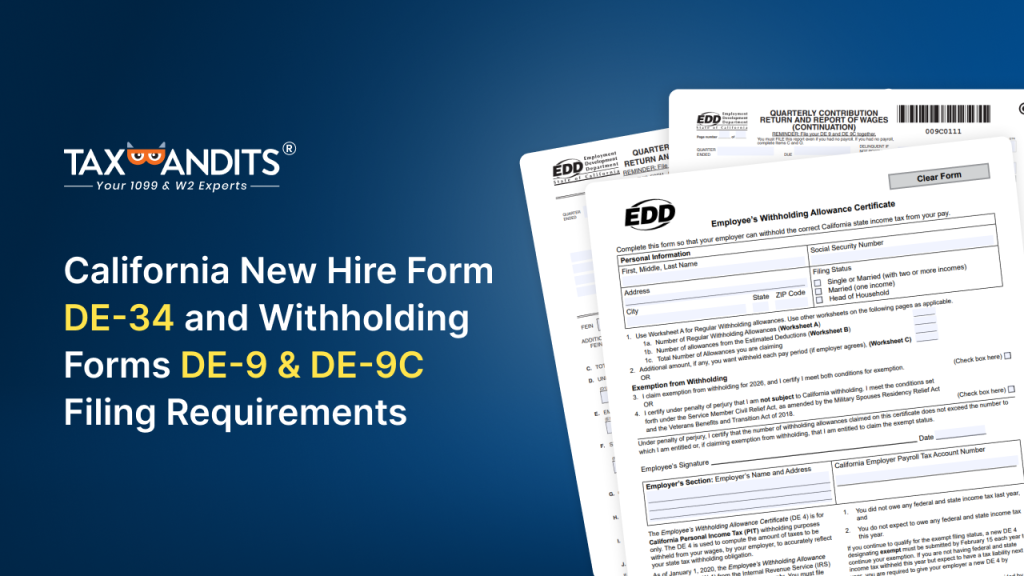
Hiring a new employee feels like a fresh chapter for your business. If you’re operating in California, as soon as your new employee starts, reporting to the state is required.
Within 20 days of an employee’s start date, employers generally need to file Form DE-34 with the state of California. But that’s not where the reporting ends. Once payroll starts, employers also navigate the quarterly cycle of reporting wages, withholdings, and payroll contributions through Forms DE-9 and DE-9C.
There are several payroll reporting responsibilities to track. Knowing which form to file, what information to provide, and when each filing is due can help you avoid last-minute scrambling and costly penalties.
Let’s walk through California’s payroll reporting requirements, starting with the first step after bringing a new employee on board: Form DE-34.
What is Form DE-34?
Form DE-34, Report of New Employee(s), is used to report newly hired employees working in California to the Employment Development Department (EDD). Note: Employers must also report employees who are rehired after being separated for at least 60 consecutive days.
The requirement applies to employers across California. New hire information also helps state and county agencies enforce child support obligations.
What information is required?
You’ll need information about both the employer and the employee to complete the California new hire report:
Employer information includes:
- California employer payroll tax account number
- Federal Employer Identification Number (FEIN)
- Business name and address
- Contact person’s name and phone number
Employee information includes:
- First name, middle initial, and last name
- Social Security number
- Home address
- Start-of-work date
When is Form DE-34 due?
Generally, you must file Form DE-34 within 20 calendar days of the employee’s start date. The same 20-day requirement applies to qualifying rehired employees.
What are the penalties for late or missing DE-34 reporting?
Missing the reporting deadline can result in a $24 penalty for each unreported employee. If an employer and employee intentionally agree not to provide the required information, or provide false or incomplete information, the penalty can be $490 per failure.
The new hire report is done. What comes next? Now, let’s look at the quarterly payroll reporting you’ll need to handle through Forms DE-9 and DE-9C.
What are Forms DE-9 and DE-9C?
Form DE-9, Quarterly Contribution Return and Report of Wages, is used to reconcile the wages reported and payroll taxes paid for the quarter.
Form DE-9C, Quarterly Contribution Return and Report of Wages (Continuation), provides employee-level wage information for the quarter, including wages subject to Unemployment Insurance (UI), Employment Training Tax (ETT), and State Disability Insurance (SDI), along with Personal Income Tax (PIT) wages and PIT withheld. Employers must file both forms each quarter.
In simple terms, the DE-9 summarizes the quarterly payroll information, while the DE-9C provides the employee-level wage details.
What information is required?
For the Form DE-9, you’ll need:
- Total number of employees for the quarter
- Total subject or taxable wages
- UI, ETT, and SDI contribution information
- California PIT withheld
- Payroll taxes and contributions reported for the quarter
For the Form DE-9C, you’ll need:
- Employee name and SSN
- Total wages for the quarter
- PIT wages
- PIT withheld
- Required wage classifications
- Employee-specific wage information
When are Forms DE-9 and DE-9C due?
Employers must file Form DE-9 and DE-9C by the last day of the month following each quarter.
- Q1 (January–March): April 30
- Q2 (April – June): July 31
- Q3 (July – September): October 31
- Q4 (October – December): January 31
If a due date falls on a weekend or legal holiday, the next business day is considered the last timely date.
What are the penalties for late filing or payment?
Missing a California payroll filing deadline can lead to penalties and interest. The amount depends on the type of filing or payment involved.
- DE-9: A $50 penalty per late return may apply.
- DE-9C: A $20 penalty per employee wage item may apply for late or missing wage reporting. If the EDD issues a demand for the DE-9C and the report is not filed within 15 days, the $20 penalty may apply to each unreported employee.
- Late payment: A 15% penalty on the amount due, plus interest, may apply to late payroll tax payments.
- E-file violation: Penalties may also apply when employers fail to meet California’s electronic filing requirements.
Filing without missing anything
The two requirements follow different timelines, which makes them easy to lose track of. Before submitting either filing, it helps to run through a few basic checks:
- Confirm which form applies. Is it a new hire report (DE-34) or a quarterly return (DE-9/DE-9C)?
- Gather the required details. Have the necessary employer and employee information ready.
- Double-check the numbers. Review wage totals and withholding amounts before submitting.
- File electronically. Submit the required form by the applicable deadline.
- Save the confirmation. Keep a copy of the filing confirmation for your records.
Make payroll tax reporting easier with TaxBandits
What starts with reporting a new hire can soon become an ongoing payroll task. TaxBandits helps simplify that process by giving you a convenient way to prepare, review, and e-file your California payroll tax forms from one platform.
With a guided filing experience, you can spend less time managing payroll paperwork and more time focusing on your business.
Get started with TaxBandits today and make California payroll reporting one less thing to worry about.
Leave a Comment